
The Rwanda Football Federation (FERWAFA) has approved a series of reforms set to take effect in the 2026/27 season, including unannounced anti-doping tests for players, increased competition registration fees, and a comprehensive branding overhaul.
The decisions were made during a FERWAFA Executive Committee meeting held Wednesday, July 1, 2026, as the governing body moves to strengthen competition oversight and modernize its football structures.
Under the new anti-doping policy, players will undergo random, unannounced health checks aimed at detecting the use of banned substances and performance-enhancing drugs. FERWAFA said the measure is intended to improve competition integrity and safeguard player health.
The federation said doping covers 11 violations, including the use or attempted use of prohibited substances, refusal to undergo testing, involvement in doping practices, and interference with testing procedures.
FERWAFA also approved new registration fees for competitions covering the 2026/27 and 2027/28 seasons. Clubs in the BK Pro League will pay RWF 2 million to register.
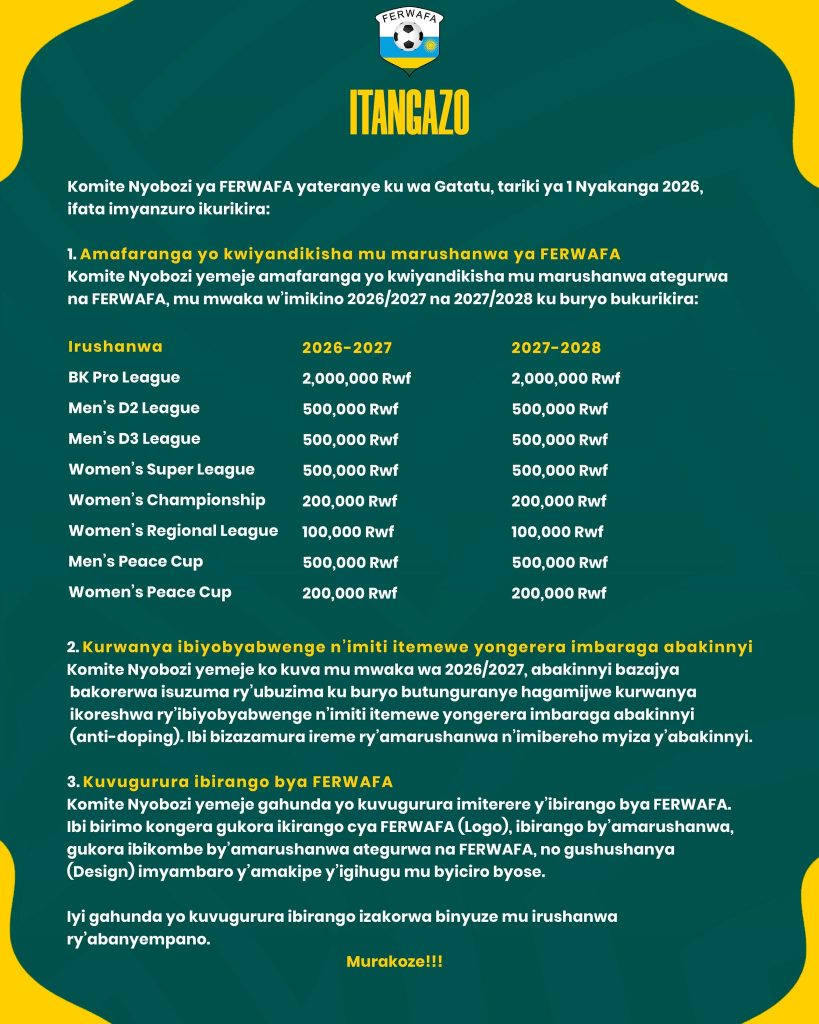
Participation in the second division, the Women’s Super League, and the Men’s Peace Cup will cost RWF 500,000.
Women’s second-division teams and entrants in the Women’s Peace Cup will pay RWF 200,000, while women’s regional competitions will require a RWF 100,000 registration fee.
In addition, FERWAFA announced plans to overhaul its branding, including redesigning its logo, competition trophies, and national team kits across all categories. The federation said the redesign will be selected through a competition involving designers and creative professionals.
The 2026/27 Rwanda Premier League season is scheduled to begin Sept. 4, 2026, and conclude May 30, 2027.
A Rwanda Olympic Committee study conducted in January 2024 found that 97.1% of respondents were aware of doping, though only 15.9% said they had strong confidence in their knowledge of the issue. Most respondents said they received information through the media.
FERWAFA said the reforms are aimed at raising competition standards, strengthening player welfare, and improving the image of football in Rwanda.