

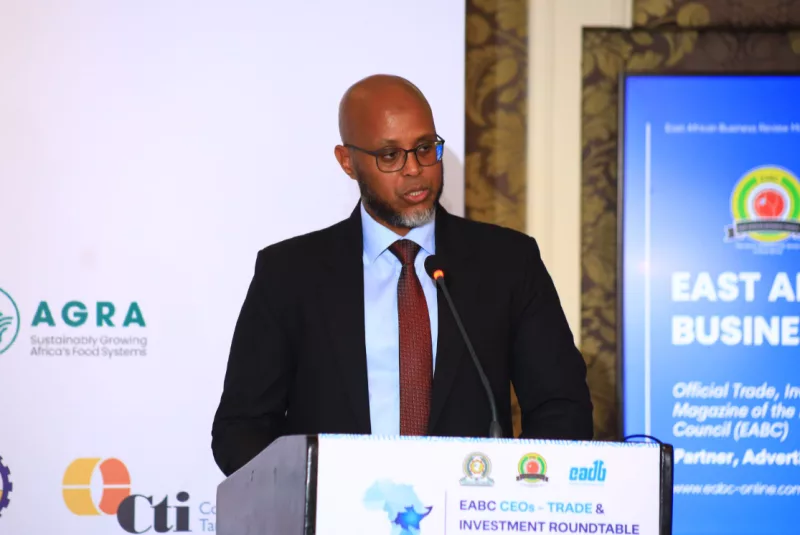
Kenyan businesses are calling for faster action to remove barriers to trade across the East African Community, saying border delays, high logistics costs and differing regulations are limiting opportunities in the region’s market.
The concerns were raised at a CEOs-Trade and Investment Roundtable in Nairobi, where business leaders said deeper regional integration could help Kenyan companies expand into other EAC markets and attract more investment. The issues are also relevant to businesses across the bloc, including Rwanda, where companies face similar challenges involving transport, border procedures, payments and regulatory requirements.
Ahmed Farah, executive director of the East African Business Council, described the EAC as Kenya’s next major growth frontier. He said intra-EAC trade stood at about $19.7 billion, or roughly 12.5% of total EAC trade, compared with a regional economy valued at about $400 billion.
Farah called for the removal of non-tariff barriers, harmonization of standards, lower logistics costs and consistent implementation of regional agreements.
Kenya Investment Authority CEO John Mwendwa said investors are looking for scale, predictable policies, skilled workers, market access and opportunities to join regional value chains. He urged EAC countries to develop complementary industries rather than compete for the same investments.
Mwendwa also called for greater digital integration and interoperability of government systems to reduce the cost and time involved in cross-border trade.
Duncan Onyango, CEO of Trade Catalyst Africa, said companies need more than production capacity to compete. They must also be able to finance operations, move goods efficiently, receive payments and remain profitable after crossing borders.
Ashif Kassam, executive chairman of RSM Eastern Africa LLP, said the EAC’s population of more than 360 million provides significant market potential, but much of that potential remains untapped.
Businesses proposed faster mechanisms for resolving non-tariff barriers, improved transport infrastructure, simpler border procedures and harmonized standards and licensing requirements.
They also called for interoperable regional payment systems, cheaper regional air travel and expansion of the East Africa Tourist Visa to support trade, investment and tourism.