
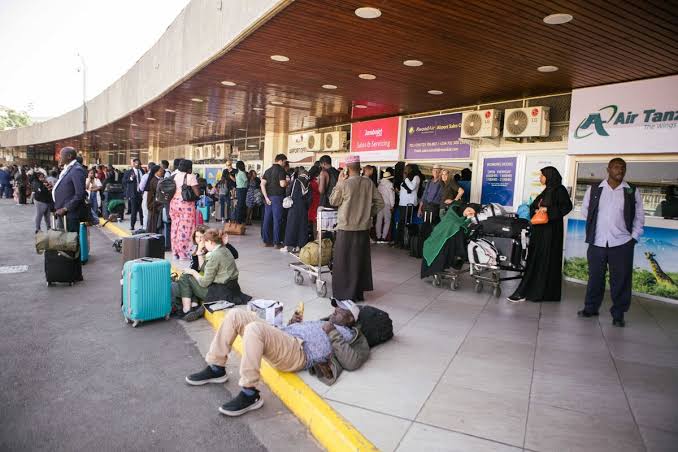
Kenya’s aviation workers ended a two-day strike Tuesday after reaching a return-to-work agreement with the government and aviation authorities, bringing an immediate end to a stoppage that disrupted flights and left passengers stranded at major airports.
The Kenya Aviation Workers Union (KAWU) called off the strike after reaching an agreement with the Ministry of Transport, Kenya Airports Authority (KAA), Kenya Civil Aviation Authority (KCAA) and Jambojet.
The strike, which began Sunday, affected operations at Jomo Kenyatta International Airport (JKIA) in Nairobi, as well as airports in Mombasa, Kisumu and Eldoret. Flight cancellations and lengthy delays disrupted travel plans as airlines worked to manage the backlog.
The impact extended beyond Kenya, with airlines adjusting schedules and passengers affected across East Africa and on international connections through Nairobi. RwandAir cancelled its WB452 and WB453 services between Kigali and Nairobi Monday because of air-traffic-control constraints at JKIA.
Nairobi is a major transit point for travelers from Rwanda and other countries in the region, meaning disruption at JKIA can affect passengers whose final destinations are beyond Kenya.
Kenya Airways was also affected, with flights delayed as the airline worked to clear passengers and aircraft caught up in the disruption.
The return-to-work agreement addresses some of the issues that led to the strike. KAA will immediately remit agency fees owed to KAWU and currently held by the authority.
KAWU and KCAA will also resume negotiations on a new collective bargaining agreement, with KCAA committing to honor and implement the outcome of the talks.
The negotiations will follow new parameters issued by Kenya’s Salaries and Remuneration Commission on Tuesday after it withdrew an earlier advisory dated July 28.
KAWU said it had reservations about the new parameters but would seek to address its concerns during the negotiations.
The agreement also leaves a separate dispute between KAWU and Jambojet over union recognition to the courts. The two sides agreed to await the court’s ruling and abide by the eventual decision.
Jambojet also committed to complying with legal and procedural requirements relating to trade union recognition.
Workers who participated in the strike will not face victimization, intimidation, discrimination or disciplinary action because of their involvement in the industrial action.
KAWU directed its members to resume their normal duties and cooperate with management to restore operations.
The parties also agreed to maintain industrial peace and resolve outstanding disputes through consultation, negotiations and established dispute-resolution mechanisms.
The latest strike was the second major aviation labor disruption in Kenya this year. A similar stoppage in February disrupted operations at JKIA and affected air traffic before workers returned to duty following an agreement with authorities.
With the strike over, airlines and airport authorities must now clear the disruption and return flight schedules to normal while the unresolved labor issues move back to the negotiating table.