
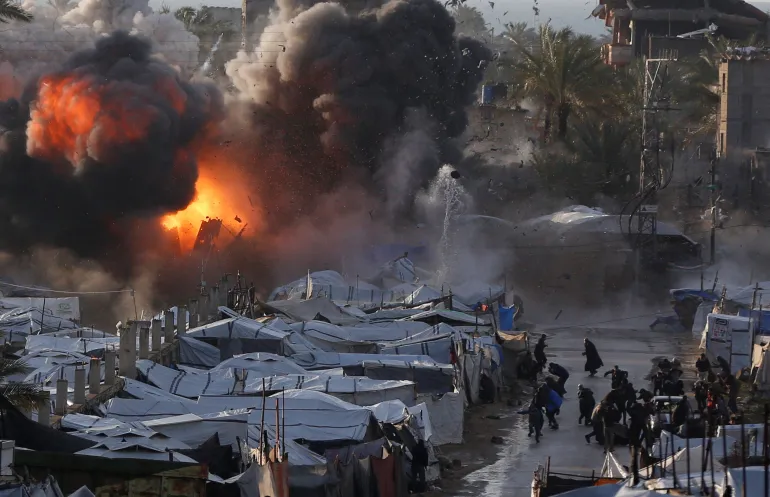
Three years after the Hamas-led Oct. 7, 2023 attack that triggered Israel’s war in Gaza, the conflict has left a mark well beyond the battlefield, reshaping Israeli political debate, public attitudes and the country’s relationship with the outside world.
Former Israeli diplomat Alon Liel, who served as director general of the Foreign Ministry and as ambassador to South Africa, says the war has pushed much of Israel’s Jewish public toward greater nationalism, fear and hostility toward Palestinians while narrowing the political space for advocates of a negotiated peace.
“The word peace disappeared,” Liel said in an interview with Anadolu. He argued that Israeli politicians now face a political risk if they campaign openly for peace because much of the public no longer believes a settlement is possible.
That view is reflected in a September survey by the Pew Research Center. Only 17% of Israelis said Israel and an independent Palestinian state could coexist peacefully, while 56% said such coexistence was not possible. The survey was conducted in March and April 2026, during the war with Iran and around an initial ceasefire.
The figures point to one of the war’s most consequential effects inside Israel: security and the conflict with the Palestinians remain central to political choices, while the idea of a negotiated two-state settlement has become increasingly difficult to sell to the public.
War dominates the election
The Oct. 27 parliamentary election is being fought against that backdrop.
An Israel Democracy Institute survey published in September found that 68% of Jewish Israelis considered the Oct. 7 attacks a central factor in deciding which party to support. Among Jewish voters, foreign affairs and security ranked ahead of most other considerations, although economic issues and the cost of living remained important, particularly among voters on the political center and left.
The election does not, however, amount to a straightforward endorsement of Prime Minister Benjamin Netanyahu’s government.
Recent polling has shown Netanyahu’s bloc and the opposition competing closely, with neither side consistently securing the 61 seats needed for a parliamentary majority. A Sept. 25 poll put the two major blocs at 53 seats each, while an Oct. 1 poll showed Netanyahu’s bloc moving ahead but still short of a majority. Gadi Eisenkot’s Yashar faction was tied with Likud as the largest individual party in the latter survey.
The political divisions predate the Gaza war. Mass protests over Netanyahu’s proposed judicial overhaul in 2023 exposed deep disagreements over the country’s democratic institutions and political direction.
But Liel argues that the war has reinforced a shift to the right and made peace even less prominent in mainstream political debate.
“The Israeli public, especially the Jewish public, moved towards nationalistic attitude. More hatred, more fear, more feelings of revenge,” he said.
Dissent under pressure
The conflict has also intensified arguments over the limits of political and cultural dissent.
Balad leader Sami Abu Shehadeh withdrew his candidacy for the October election after Israel’s Supreme Court signalled that it was likely to uphold his disqualification. Adalah, which represented the parties and candidates, said Abu Shehadeh chose to withdraw to avoid establishing a legal precedent that could further restrict Palestinian political participation.
The court subsequently allowed the Joint Arab List and United Arab List to contest the election after overturning their disqualification by the Central Elections Committee.
Cultural figures have also faced political pressure.
Culture Minister Miki Zohar said in September that he would seek to revoke the citizenship of filmmakers Yuval Abraham and Rachel Szor after their documentary NAZA received the Special Jury Prize at the Venice Film Festival. Zohar described the film as harmful to Israel and accused the filmmakers of treason.
The film includes testimony from Israeli military and intelligence personnel about Israel’s conduct during the Gaza war. The dispute has become another example of how criticism of the war can become a political flashpoint inside Israel.
Conflict beyond Gaza
The war has also coincided with a widening regional confrontation, including fighting involving Hezbollah in Lebanon and a direct confrontation with Iran.
In March, an Israel Democracy Institute survey found that 82% of Israelis supported Israel’s military operation against Iran, including 93% of Jewish respondents. The figures illustrate the strong public backing for military action when Israelis perceive a direct security threat.
The conflict has also affected Israel’s occupied West Bank.
The U.N. Office for the Coordination of Humanitarian Affairs documented more than 1,600 settler attacks resulting in Palestinian casualties or property damage between January and August 2026. The incidents affected 275 Palestinian communities and averaged 6.7 attacks a day, compared with five a day in 2025.
A separate U.N. human rights report said Israeli forces forcibly displaced the populations of the Jenin, Nur Shams and Tulkarem refugee camps during operations in early 2025 and have continued to prevent residents from returning. More than 33,000 Palestinians were displaced from the three camps, according to U.N. figures.
The war’s wider social effects have also been felt by minority communities. The Rossing Center for Education and Dialogue recorded 155 incidents targeting Christians in Israel and East Jerusalem in 2025, including 61 physical attacks and 52 attacks against church property.
More Israelis leaving
Another sign of the strain is the rise in emigration.
Data presented to the Knesset in June showed that an average of about 40,500 Israelis emigrated annually between 2009 and 2021. The number rose to 59,400 in 2022, 82,800 in 2023 and 69,500 in 2024.
The increase does not by itself establish that the Gaza war was the sole cause. Israel was already experiencing major political divisions before October 2023, and emigration is influenced by economic, political and personal factors.
Still, the figures have become part of a wider debate about whether prolonged conflict and political instability are making Israel less attractive to some of its citizens.
A growing international cost
The war has also damaged Israel’s standing abroad.
A Pew Research Center survey published in June found unfavorable views of Israel in 78% of adults in Spain, 73% in Germany, 65% in Canada and 60% in the United States. In the United States, the unfavorable rating rose seven percentage points from 2025, while Germany’s increased by nine points.
Israeli public opinion also recognizes the deterioration. An Israel Democracy Institute survey conducted in 2025 found that 73% of Israelis believed Israel’s international standing had become worse than it was before the Oct. 7 attacks.
For Liel, the result is a country that is more isolated internationally and further removed from the political language of peace than it was before the war.
“Israel is much weaker now internationally,” he said.
Three years after Oct. 7, the political consequences therefore extend beyond the question of who wins the next election. The war has altered the issues that dominate Israeli politics, hardened attitudes toward the Palestinian conflict and intensified debates over dissent, security and Israel’s place in the international community.