
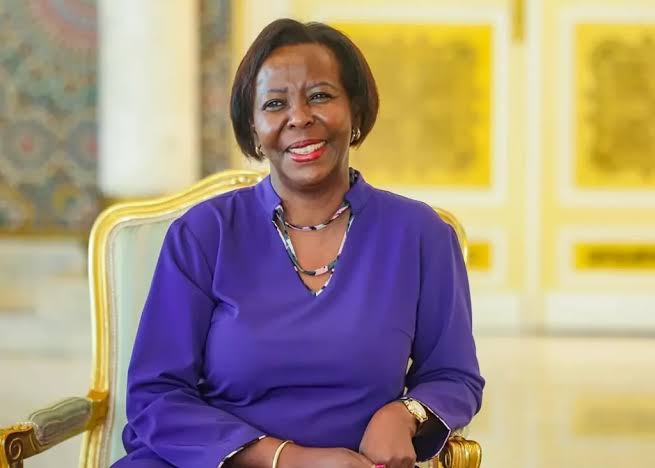
Organisation Internationale de la Francophonie (OIF) Secretary General Louise Mushikiwabo says she is not worried about facing an election for the first time as she seeks another term leading the French-speaking countries’ organisation.
Mushikiwabo said in an interview with France 24 on September 25 that her confidence was based on her record at the OIF and support she said she had received from several member countries.
She is seeking another four-year term at the head of the organisation, where she has served as secretary general since 2019 after first being elected in 2018 and re-elected in 2022.
She will face three other candidates: Mauritania’s Coumba Bâ, former Romanian prime minister Dacian Cioloș and Democratic Republic of Congo’s Juliana Amato Lumumba. The four candidates formally presented their plans to OIF foreign ministers in June, in a new process introduced as part of reforms to how the organisation chooses its leader.
The election will take place at the OIF summit in Phnom Penh, Cambodia, on November 16. The organisation says the 53 full member states and governments will take part in the vote.
Mushikiwabo said she welcomed the move from consensus-based selection to an election, describing it as a sign of the organisation’s development after 56 years.
“I am not afraid of elections,” she said, arguing that she had supported the inclusion of voting rules in OIF reforms for situations where members cannot agree on a single candidate.
Asked whether she believed she had the strongest chance of winning, Mushikiwabo declined to make such a claim.
“It would be presumptuous to say, ‘I am the one with the best chances,’ because in an election, it is decided at the end,” she said.
She added that she had a record she believed had been recognised by heads of state and said several countries had told her they supported her candidacy.
The election is also taking place amid tensions between Rwanda and the Democratic Republic of Congo, whose candidate is also seeking the OIF post.
Mushikiwabo said the dispute between the two countries should not become part of the OIF contest, arguing that candidates should be judged on their ability to lead the organisation.
She also said she wanted Mali, Burkina Faso and Niger to return to the OIF after the three Sahel countries left the organisation in 2025.
“I was very saddened by the departure of the three Sahel countries,” she said, adding that she wanted them to return because the OIF belongs to them as well.