

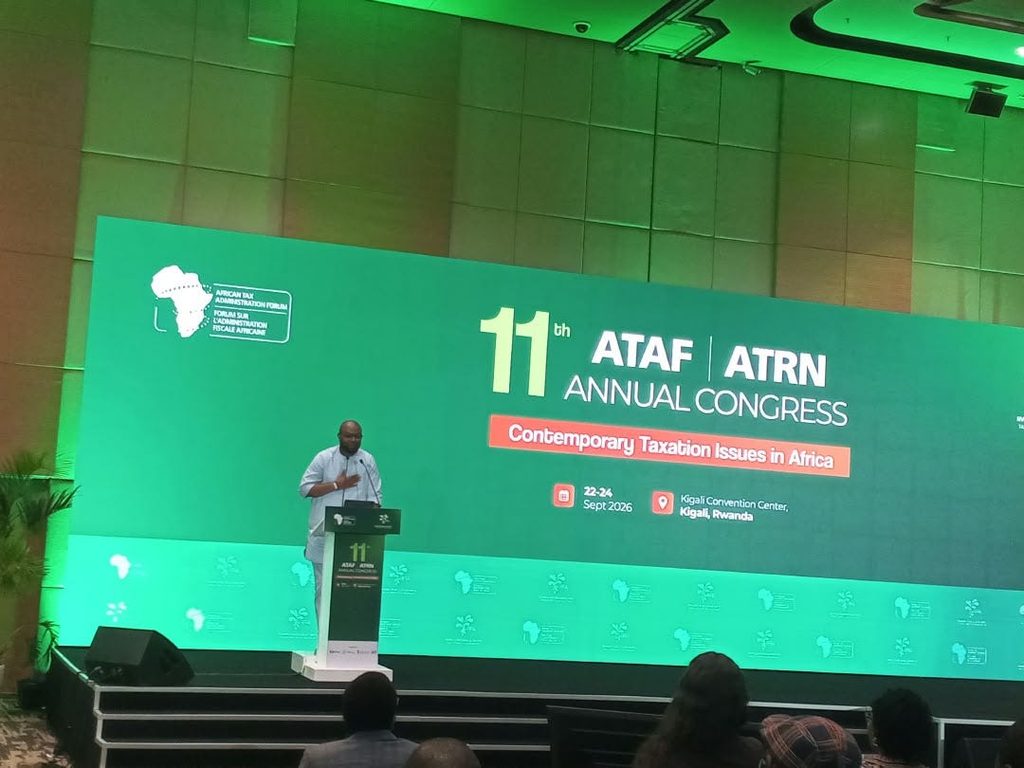
Tax research in Africa needs to move more effectively from academic papers to the institutions responsible for making and implementing policy, an African Tax Administration Forum (ATAF) official said Tuesday as researchers gathered in Kigali.
Emeka Nwankwo, ATAF’s Head of Domestic Tax and Capacity Building, said the continent needed stronger evidence to determine which tax measures work, who benefits from them, under what conditions and at what cost.
He was speaking on behalf of ATAF Executive Secretary Mary Baine at the opening of the 11th African Tax Research Network (ATRN) Annual Congress at the Kigali Convention Centre.
The three-day congress, running from Sept. 22–24, is being held under the theme “Contemporary Taxation Issues in Africa” and brings together researchers, tax administrators, policymakers and other stakeholders to examine emerging challenges facing African tax systems.
The congress received 190 research paper submissions this year, compared with 151 for the 10th Congress in Cape Town.
Of those submissions, 164 went through double-blind peer review by 114 members of the Scientific Committee, who conducted 356 individual reviews.
Forty-eight papers were selected for full presentation and seven for poster presentation, while 40 were placed on a capacity-building track to give their authors mentoring towards publication.
“We are not only selecting excellence; we are developing it,” Nwankwo said.
He said ATAF wanted to build what it calls “research liquidity” — a system where policymakers and tax administrators can quickly find useful evidence while researchers can connect their work with institutions able to act on it.
Nwankwo said questions about tax exemptions, value-added tax gaps, informal-sector taxation and the effect of digitalisation on tax compliance required more research.
“The quality of the answers will determine whether RADA doubles our impact or merely doubles our activity,” he said.
Closing Africa’s revenue gap
The research discussion comes against a backdrop of low tax collection across much of the continent.
Nwankwo said tax revenue averaged 15% of GDP across 39 African countries in 2024, compared with 33.9% for OECD countries, 21.3% for Latin America and the Caribbean and 19.6% for Asia and the Pacific.
“On a continental output of roughly three trillion dollars, each additional percentage point of GDP raised in tax is worth in the order of thirty billion dollars a year,” he said.
Nwankwo said raising Africa’s average tax-to-GDP ratio to the level of Latin America and the Caribbean could close much of the estimated $194 billion annual financing gap for the continent’s Sustainable Development Goals.
He said the need to improve domestic revenue mobilisation had become more urgent after official development assistance declined 23.1% in real terms in 2025, the largest annual decline on record.
ATAF’s revenue initiative
ATAF launched Revenue Action for Development in Africa, or RADA, at the Fourth International Conference on Financing for Development in Sevilla in July 2025.
The initiative aims to double ATAF’s impact for member administrations by 2030.
Since 2016, ATAF-supported interventions have generated more than $6 billion in additional tax assessments, with $2.8 billion collected into member treasuries.
In 2025, the interventions generated $907.8 million in assessments and $685.8 million in collections.
RADA focuses on four areas: digital tax infrastructure, including an automatic exchange of information platform; rapid country support; capacity and skills development through a multilingual Tax Academy; and inclusive tax governance.
Nwankwo said the success of these efforts depended on research and on stronger links between researchers, finance ministries, revenue administrations and legislators.
“Research works in exactly the same way,” he said. “On one side stand researchers and the evidence they produce; on the other stand the finance ministries, revenue administrations and legislators who need it.”
The ATRN, established in 2013, is intended to provide that link between research and tax policy and administration.
ATAF is using the network’s peer-review system, congress, journal, tax outlooks, mentorship programmes and research partnerships to strengthen the connection.
The African Multidisciplinary Tax Journal has also expanded its output. Nwankwo said it has been indexed in Scopus since January 2025, while its sixth volume contains 16 peer-reviewed papers in English, French and Portuguese from 82 submissions.
ATAF is preparing an application for Web of Science indexing and considering whether the journal should publish two issues a year.
Research presented at the Kigali congress will feed into ATAF’s 2026 Annual Meetings and Technical Conference in Cairo from Nov. 1–5, whose theme will be “The Revenue Imperative: Africa’s Path to Financing Its Own Development.”
Nwankwo said Africa’s path to higher domestic revenue should be based on evidence generated and tested within the continent.
“It will be built on African evidence, produced by African researchers, tested against African administrative reality, and put to work by African decision makers,” he said.