
Rwanda’s economy grew 10% in the first quarter of 2026, the government said Tuesday, as the Cabinet approved a series of tax, governance and development measures aimed at strengthening public administration and supporting growth.
The growth covers the January–March period and reflects broad gains across agriculture, industry and services despite continued global economic uncertainty, according to figures presented during a Cabinet meeting chaired by President Paul Kagame at Urugwiro Village.
Gross domestic product rose to 6.346 trillion Rwandan francs in the first quarter, up from 5.276 trillion francs in the same period in 2025, the government said.
Services accounted for 52% of output, followed by industry at 24% and agriculture at 19%, while other sectors made up 5%.
Industrial production increased 13%, agriculture rose 8% and services grew 7%, driven by manufacturing, mining, construction, information and communications technology, and export-oriented agriculture.
The government said it continues to monitor developments in global trade and their potential impact on the domestic economy, adding that it would take measures to maintain macroeconomic stability where necessary.
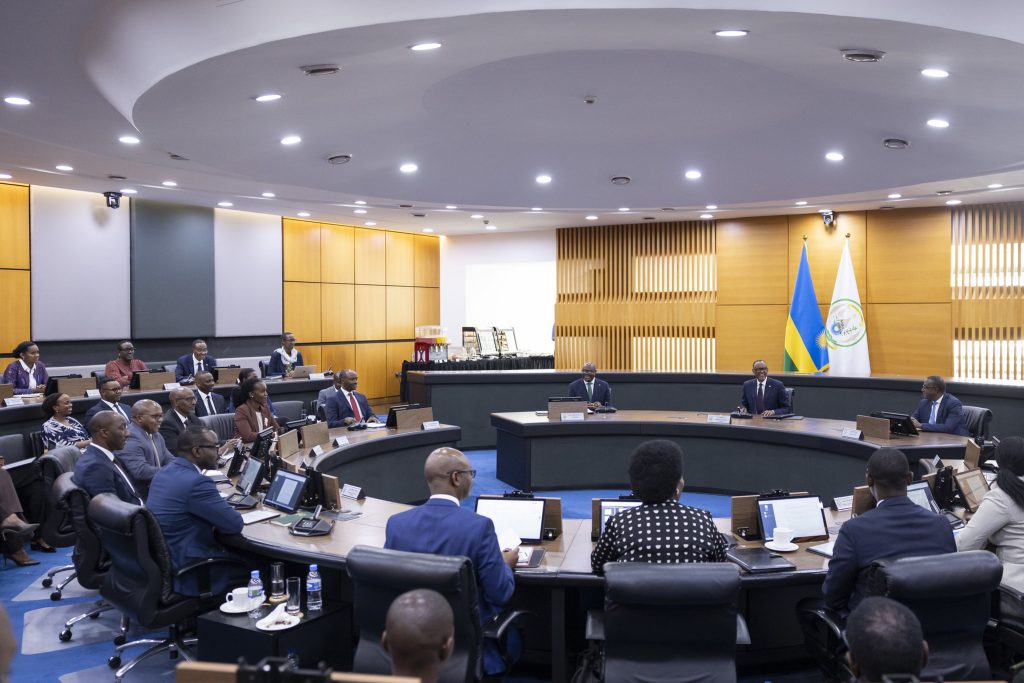
Alongside the economic update, the Cabinet approved reforms to tax administration and governance structures, including draft legislation ratifying international financing agreements.
These include a loan from the French Development Agency (AFD) to support Rwanda’s health sector and a World Bank-linked grant aimed at strengthening preparedness and response to disease outbreaks through global health financing mechanisms.
Two additional loans from the International Development Association were approved to support commercial agriculture development and improve livelihoods.
The Cabinet also approved the establishment of a Tax Policy Committee to guide tax policy formulation and broaden stakeholder participation.
Other tax measures include updated rules on electronic invoicing, tax deductions and incentives for individuals who report tax evasion. Officials said the changes are intended to improve compliance and strengthen revenue collection.
Additional regulations set conditions for tax relief for deposit-taking microfinance institutions and revise accounting and turnover thresholds for businesses required to maintain certified records for tax purposes.
In governance reforms, the Cabinet approved new electoral regulations governing local government leadership and executive committees of national councils representing women, youth and persons with disabilities.
Officials said the changes are intended to improve representation and participation in governance structures at all levels.
The Cabinet also approved the issuance of mining and quarrying licences.
On diplomatic matters, the government approved the accreditation of Mohamed Basheer Abdalla Mennawi as Sudan’s ambassador to Rwanda and Huh Jungae as South Korea’s ambassador to Rwanda, both based in Kigali.
It also approved Sakamoto Atsuki as the Japan International Cooperation Agency (JICA) representative in Rwanda and endorsed Jim Hegarty to represent Rwanda’s interests in Ireland.
Separately, officials said the 16th edition of the Itorero Indangamirwa civic training programme will take place from July 1 to Aug. 10 at the Gabiro Military Training School.
The Ministry of Defence said the 2026 joint community outreach programme involving the Rwanda Defence Force, Rwanda National Police and local communities had concluded, with project handovers scheduled for July 4 during Liberation Day celebrations.
The Ministry of Agriculture and Animal Resources also announced that the National Agriculture and Livestock Exhibition will be held in Kigali from July 22 to 31 at the Mulindi Expo Grounds.