
Kenya has confirmed a third case of Bundibugyo Ebola, while the outbreak in neighbouring Democratic Republic of Congo (DRC) has spread to an eighth province, increasing concerns about cross-border transmission.
Kenya’s latest patient is a 65-year-old woman who is a close relative of the country’s first two confirmed cases. She had been in quarantine since October 6 and tested positive after developing symptoms, the Ministry of Health said on Friday, October 16.
The woman developed fever, a sore throat and general weakness before being isolated and tested. Health officials said early detection had improved her chances of recovery. The country’s first patient died on October 5, while the second confirmed case was reported on October 14.
Kenyan authorities have said the three cases are linked and that there is no evidence of community transmission. Officials were continuing to trace contacts and monitor people who may have been exposed to the virus.
The cases are linked to the outbreak in the DRC, where infections have continued to spread despite containment efforts. On October 15, two health officials told Reuters that two Ebola cases had been detected in North Ubangi, a province bordering the Central African Republic. Congolese authorities had not officially announced the infections at the time.
North Ubangi became the eighth province affected by the outbreak, following Ituri, North Kivu, South Kivu, Tshopo, Haut-Uele, Bas-Uele and South Ubangi.
Ituri remains the main centre of the outbreak, while North Kivu has also experienced a recent increase in cases. The spread into North Ubangi adds another challenge for health teams working to identify infections and limit further transmission.
According to figures reported by Reuters on October 13, the DRC had recorded more than 9,000 confirmed cases and 4,381 deaths. The outbreak, caused by the Bundibugyo virus, was declared in May.
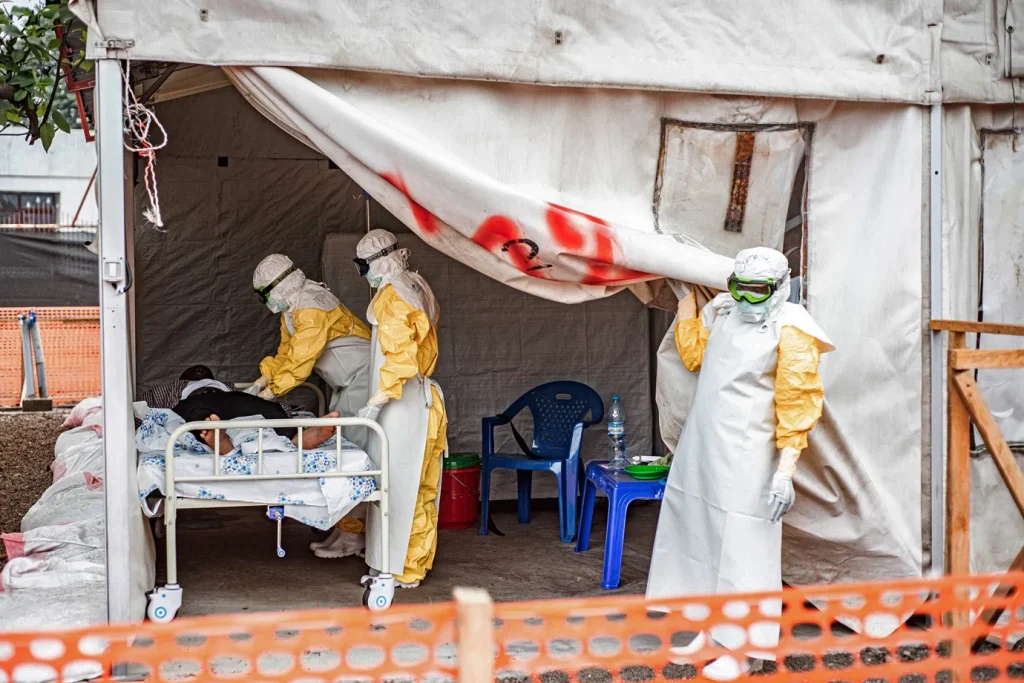
The strain has no licensed vaccine or specific approved treatment, complicating efforts to contain the disease. Public health authorities have relied on isolation, supportive care, contact tracing and community surveillance.
Kenya has strengthened screening and monitoring measures following the imported case. The World Health Organization has also reported response measures in Kenya and Uganda, where authorities have been tracking people who may have been exposed during travel.
The outbreak highlights the difficulty of containing Ebola when people move across borders and infections are detected in several locations. Health authorities continue to stress early reporting of symptoms and prompt identification of contacts as essential measures to limit further spread.