
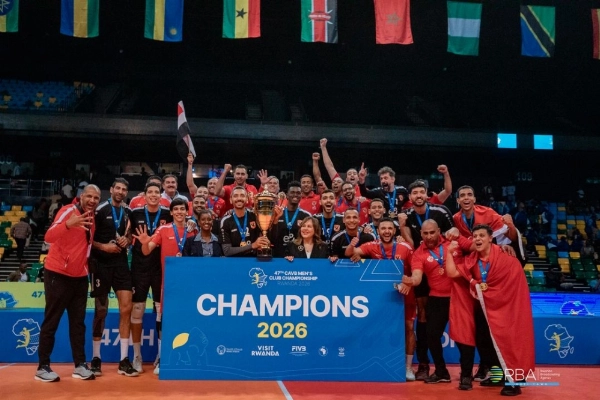
The 47th Confederation of African Volleyball (CAVB) Men’s Club Championship concluded in Kigali on May 2, 2026, reinforcing Rwanda’s growing reputation as a destination for major international sport.
The tournament, also known as #MAVCC2026, ran from April 20 and marked a historic milestone as the first time a subSaharan African country hosted the continent’s premier men’s club volleyball competition.
Matches were staged at BK Arena and Petit Stade, bringing together more than 24 clubs from 15 countries.
While Egyptian giants Al Ahly SC retained their continental dominance by winning a record 17th title, the wider story in Kigali centered on Rwanda’s rising profile and the tournament’s expanding reach.
Al Ahly defeated Rwanda’s Police VC in straight sets (25–20, 25–21, 25–22) in the final, completing a f lawless campaign without dropping a set.
Cuban opposite hitter Masso Alvarez led the final with 13 points, while Abdelrahman Elhossiny Eissa was named Most Valuable Player after finishing the tournament with 60 points.
Police VC made history as the first Rwandan club to reach the final, securing silver, while Rwanda Energy Group (REG VC) added bronze to complete a strong showing for the hosts.
Rwanda was represented by several clubs, including Police VC, Rwanda Energy Group (REG VC), APR VC, Kepler VC and Gisagara VC.
Police VC delivered the standout performance by reaching the final for the first time in history, while REG VC secured a podium finish with bronze.
The other Rwandan sides gained valuable continental experience against strong opposition, reflecting the country’s growing depth in club volleyball.
Rwanda’s growing presence Rwandan clubs have continued their upward trajectory on the continental stage.
Since Gisagara VC’s bronze medal in 2022, local teams have steadily improved, with Police VC and REG VC both finishing among Africa’s top three this year.
The results lifted Rwanda to seventh among the 54 national federations affiliated with the Confederation of African Volleyball, underlining its growing competitiveness.
East African teams also impressed, with about 80 percent reaching the knockout stages.
Only Rukinzo VC of Burundi and Prisons VC of Tanzania exited in the group phase, reflecting the region’s improving standards.
Standout performers The tournament produced several milestones.
Police VC head coach Fred Musoni, 33, became the first Rwandan coach to lead a team to a silver medal in the competition.
Al Ahly’s Eissa Elhossiny earned both Best Opposite and MVP honors, while Police VC’s Gideon Angiro became the first Ugandan player to win a medal at the championship.
REG VC’s Nicholas Matui was named Best Outside Hitter after another strong performance, further cementing his status among Africa’s leading players.
Al Ahly’s victory reinforced their status as Africa’s most successful club.
Coached by Gordon Mayforth, they won all nine matches without dropping a set, adding the continental crown to a season already marked by domestic dominance in Egypt.
Record visibility and innovation
The 2026 edition also set new benchmarks off the court.
Matches were broadcast live on Rwanda Broadcasting Agency (RBA) for the first time, while online streaming surpassed 60 million views on YouTube.
Rwanda’s visa-free policy also contributed to increased international attendance, further enhancing the event’s profile.
A key innovation was the introduction of the Video Challenge System (VCS) from the round of 16.
The system allowed teams to contest refereeing decisions, with no major issues reported, marking a successful debut for the technology in African volleyball.
Rwanda’s rising sports profile
The championship added to Rwanda’s growing list of major sporting events, following the 2025 UCI Road World Cycling Championships and the 2026 African Men’s Handball Championship.
Confederation of African Volleyball vice president Louis Rwakiranya praised Rwanda’s infrastructure and security, saying the country offers confidence for hosting major tournaments.
Rwanda Volleyball Federation president Raphael Ngarambe also said the country has expressed interest in hosting the championship for at least three consecutive editions, reflecting its long-term ambitions in international sport.
A broader impact This year’s competition featured 24 teams selected from 37 applicants across 15 countries, further strengthening Kigali’s position as a rising hub for continental sport.
Beyond the title race, the 2026 championship highlighted a shifting landscape in African volleyball one marked by rising East African competitiveness, expanding global visibility, and Rwanda’s steady emergence as a trusted host of major sporting events.