
Climate change is reshaping Rwanda’s agricultural landscape, bringing erratic rainfall, rising temperatures and crop diseases that scientists say are increasingly difficult to predict or control.
In response, the country is accelerating the development of improved seed varieties designed to withstand drought, resist disease and reduce reliance on chemical pesticides. But researchers say the challenge is not only scientific—it is also about whether farmers trust and understand the technology.
“Climate change has had major consequences for agriculture,” said Dr. Athanase Nduwumuremyi of the Rwanda Agriculture and Animal Resources Development Board (RAB). “Temperatures have increased, rainfall has become less predictable, and diseases that never existed in Rwanda before are now affecting our crops.”
“Sometimes farmers receive too little rain, while at other times rainfall is excessive,” he added.
From research to seed systems
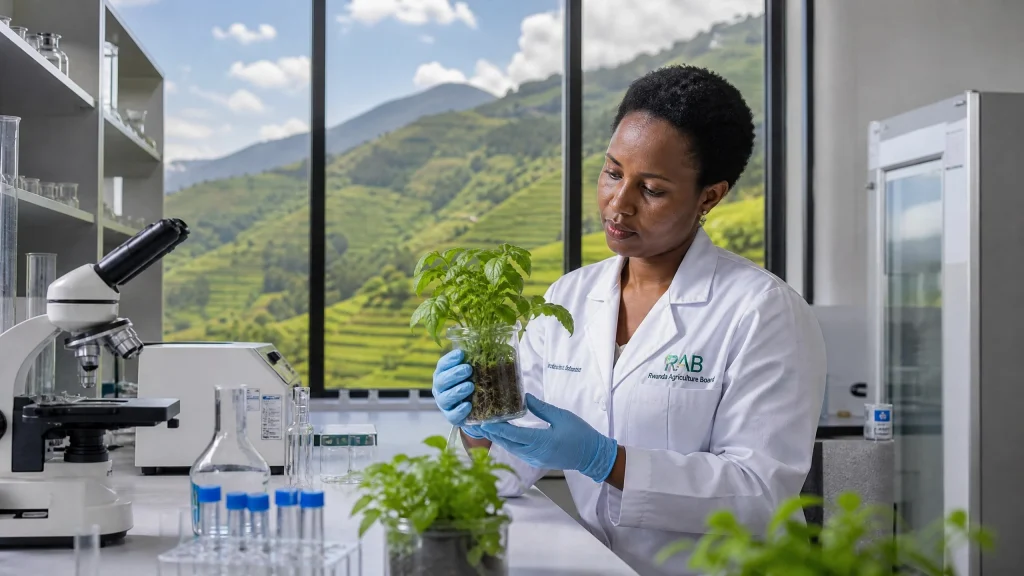
Rwanda’s approach to improving crop productivity relies on a structured seed system that begins with scientific research and ends with certified distribution to farmers.
“Every improved seed distributed to farmers starts with research at RAB,” Nduwumuremyi said. “Scientists develop and evaluate the varieties before supplying foundation seed to certified seed multipliers, who then produce enough quality seed for distribution to farmers.”
He said Rwanda has reduced dependence on imported seed for several major crops.
“Today, we are proud that Rwanda no longer depends heavily on imported seed for many important crops. Most of the improved seed used by our farmers is now produced within the country,” he said.
Climate pressure already visible in fields
Across parts of Rwanda—particularly in the north—farmers have reported declining yields in crops such as potatoes and pineapples, driven by persistent disease outbreaks and shifting weather patterns.
Scientists say these trends reflect broader changes in growing conditions that are making agriculture more unpredictable.
Out of that pressure, researchers are developing what they describe as climate-resilient crops designed to perform under harsher conditions.
“Climate-resilient crops are designed to survive these conditions by tolerating drought, resisting emerging diseases, and maintaining productivity even under environmental stress,” Nduwumuremyi said.
Speeding up crop development
Traditionally, developing new crop varieties through conventional breeding can take decades. Scientists say biotechnology is helping shorten that timeline by identifying and modifying genes linked to disease susceptibility.
“Conventional breeding involves crossing plants with desirable characteristics, but this process can take between twenty and thirty years before a new variety is ready,” Nduwumuremyi said. “Biotechnology enables us to understand precisely why a plant becomes susceptible to disease and allows us to improve that trait much faster.”
“Once we identify the responsible gene, biotechnology can silence or modify it, reducing the development time to approximately five years.”
He emphasized that biotechnology complements conventional breeding rather than replacing it.
Cassava, potatoes and disease pressure
Rwanda’s researchers point to cassava as a key example of both progress and continued vulnerability. After earlier success in controlling Cassava Mosaic Disease, farmers later faced Cassava Brown Streak Disease, which threatened production again.
“Using biotechnology, we have now developed six improved cassava varieties that resist these viral diseases,” Nduwumuremyi said. “The research has been completed, and we are now working with certified seed multipliers so farmers can access these improved varieties.”
Potatoes, another staple crop, have also been heavily affected by late blight, a fungal disease that forces farmers to rely on repeated spraying.
“Potato farmers spend substantial amounts of money purchasing fungicides to control late blight,” he said. “Through biotechnology, we have developed two potato varieties that resist this disease naturally, even under heavy rainfall.”
Researchers are also working on maize resistant to Fall Armyworm and continuing trials on bananas and other strategic crops.
Explaining biotechnology to farmers
Despite growing scientific progress, researchers say many farmers still have limited understanding of what biotechnology means in practice.
“Agricultural biotechnology uses biological knowledge to strengthen the natural defense systems of crops,” said Pacifique Nshimiyimana of the Alliance for Science Rwanda.
“It allows scientists to improve a plant’s ability to resist diseases, pests and environmental stress while maintaining its nutritional quality.”
He added: “The objective is to help farmers harvest more while spending less on pesticides and protecting the environment.”
Trust and adoption challenges
Scientists acknowledge that skepticism persists among some farmers, particularly those who have experienced crop failures linked to disease or poor-quality planting materials.
“Farmers need accurate scientific information,” Nduwumuremyi said. “Every improved seed undergoes rigorous scientific evaluation and approval before it reaches farmers.”
He added that disease-resistant crops could reduce reliance on chemical sprays.
“If crops naturally resist diseases, farmers spray fewer chemicals,” he said.
High stakes for food security
Agriculture accounts for roughly a quarter of Rwanda’s gross domestic product and employs more than 60 percent of the population, making productivity gains central to national food security efforts.
International organizations warn that the stakes are rising. The Food and Agriculture Organization estimates that improved seed varieties can increase yields by 20 to 50 percent, while up to 40 percent of global crop production is lost annually to pests and diseases. The African Development Bank has also cautioned that climate change could significantly reduce agricultural productivity across Africa without adaptation.
Beyond the laboratory
Experts say Rwanda’s agricultural future will depend not only on scientific innovation but also on whether farmers are equipped with the knowledge and confidence to adopt new technologies.
“Technology alone cannot transform agriculture,” Nshimiyimana said. “Farmers must understand why these improved seeds are being developed, how they work, and the benefits they offer.”
As Rwanda expands its investment in climate-resilient agriculture, scientists say the goal is not to replace traditional farming systems but to strengthen them.
The expectation is that seeds developed in laboratories today could become the foundation of more stable harvests in the years ahead—even as climate conditions grow increasingly uncertain.