
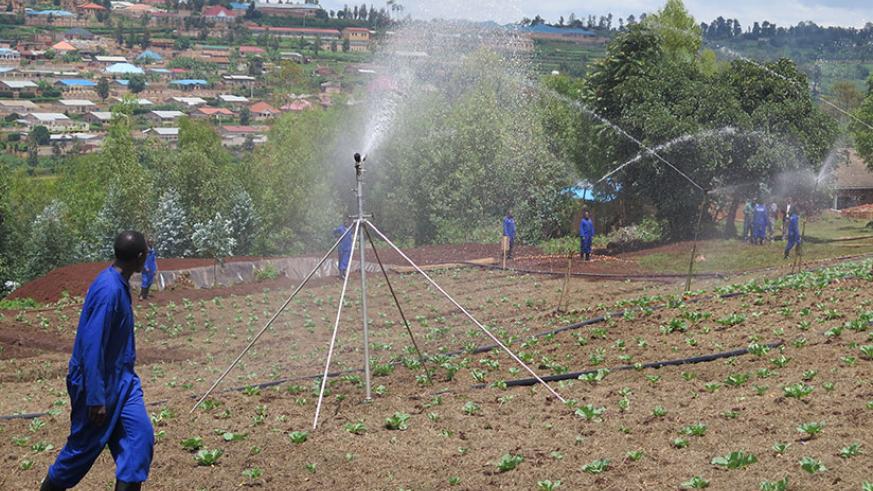
Rwanda is preparing a pipeline of irrigation projects expected to cover more than 50,000 hectares, as the government seeks to expand agricultural production and reduce farmers’ dependence on rainfall.
Agriculture Minister Dr Telesphore Ndabamenye told Parliament on October 27 that the projects, which are at different stages of preparation and implementation, would contribute to the country’s target of increasing irrigated farmland to 132,000 hectares by 2029.
The planned expansion includes projects in Kayonza, Gisagara and Gatsibo districts, as well as larger schemes in the Muvumba and Nyabarongo areas. Other initiatives, including Mugesera and Gabiro II, are also being considered for financing.
Ndabamenye said the Climate-Smart Agriculture Development Project (CDAT) currently has 10,000 hectares completing feasibility studies, with the area expected to increase to 14,000 hectares by 2029.
“There are other projects that we are also receiving support for from friendly countries,” he told lawmakers.
Among them is a project expected to provide irrigation to 6,800 hectares in Kayonza, a district that frequently experiences low rainfall. Another project recently launched in Gisagara is expected to cover 2,600 hectares.
Gatsibo District is also expected to benefit from an irrigation project covering about 800 hectares, including land on hillsides.
The minister said the government was also seeking financing for irrigation development in the Muvumba scheme, where about 10,000 hectares are planned for irrigation. Work is expected to start with 3,000 hectares, with the African Development Bank among the partners involved.
Another major initiative is Nyabarongo II, which is being developed for several purposes, including water supply, electricity generation and irrigation. Its first phase is expected to provide irrigation to 6,500 hectares, with the World Bank involved in the project.
The government is also seeking financing for the Mugesera project and plans to work with the African Development Bank on Gabiro II to expand irrigated land.
Ndabamenye said the projects, taken together, could bring more than 50,000 hectares under irrigation and help the country move towards its 2029 target.
“Looking at all these projects, they could cover more than 50,000 hectares, which would help us achieve the target we have set,” he said.
He added that expanding irrigation would require sustained investment in marshland development and the preparation of feasibility studies to speed up project implementation.
“There are many projects aimed at accelerating the expansion of irrigated land. However, we also need to continue mobilising resources to develop marshlands sustainably and prepare studies for these marshlands so that implementation can move faster,” he said.
Rwanda aims to increase irrigated farmland to 132,000 hectares by 2029, from 71,000 hectares in 2024.