
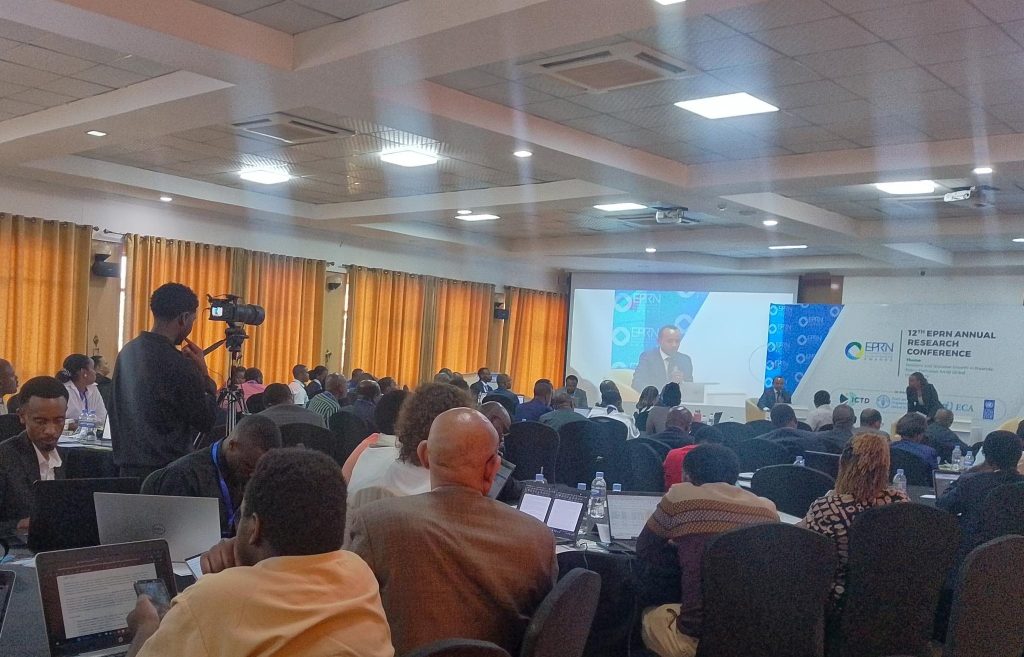
More than 350 economists from Rwanda and abroad are meeting in Kigali to explore ways the country can strengthen its resilience to economic shocks while promoting inclusive growth in line with Vision 2050 and the second National Strategy for Transformation (NST2).
The two-day economic research conference, which began on June 25, 2026, was organized by the Economic Policy Research Network (EPRN). It brings together policymakers, academics, civil society actors and development partners to share research-based policy recommendations aimed at strengthening Rwanda’s development agenda.
The discussions are focused on boosting economic resilience, transforming agriculture, expanding digital economy opportunities for young people and deepening regional cooperation within the Great Lakes region.
EPRN Executive Director Kwizera Seth said the conference is intended to identify practical solutions to help Rwanda sustain long-term, inclusive growth while responding to global uncertainties.
“We are facing conflicts, droughts and climate change, all of which affect national development,” Kwizera said. “We are looking at what can be done when development plans are disrupted by unexpected shocks.”
He added that discussions are also focusing on key sectors such as agriculture, self-reliance, regional cooperation, youth empowerment and job creation.
Agriculture remains a cornerstone of Rwanda’s economy, employing more than 60% of the population and contributing about a quarter of the country’s gross domestic product (GDP).
According to 2025 data from the National Institute of Statistics of Rwanda (NISR), the economy continued to show strong performance, with GDP growing by 8.9% in 2024, exceeding the projected 8.3%.
In the second quarter of 2025, GDP at market prices reached 5.798 trillion Rwandan francs, up from 4.966 trillion francs in the same period in 2024, representing a 7.8% increase year-on-year.
NISR data shows the services sector accounted for 50% of GDP, agriculture 23%, industry 21%, while taxes on products contributed 5%.
A 2025 report from the Ministry of Finance and Economic Planning (MINECOFIN) indicates that Rwanda’s debt-to-GDP ratio improved, falling from 74.5% in 2024 to 73.6% in 2025, reflecting continued efforts to maintain fiscal stability.
The government’s budget for the 2025/2026 fiscal year stands at 7.0325 trillion Rwandan francs, a 21% increase compared with the previous year.