
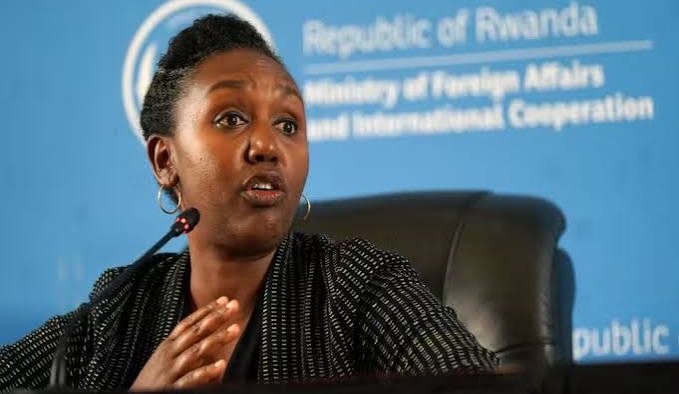
Rwanda’s government spokesperson Yolande Makolo has accused Congolese leaders of undermining peace efforts by defending the Democratic Forces for the Liberation of Rwanda (FDLR), rather than fulfilling their commitment to neutralise the armed group.
Makolo made the remarks on Thursday in response to comments by Democratic Republic of Congo (DRC) Foreign Minister Thérèse Kayikwamba Wagner, who rejected calls for the United States to impose sanctions on both countries over the conflict in eastern Congo.
The exchange followed Washington’s decision on October 28 to sanction Rwanda’s Ministry of Defence and Zigama Credit and Savings Society over alleged support for the M23 rebel movement in eastern Congo.
It began after Tibor Nagy, a former US assistant secretary of state for African affairs, questioned whether targeting Rwanda alone would help resolve the conflict. He argued that the Congolese government also had armed groups that threatened Rwanda and asked why sanctions should not apply to all parties responsible for instability.
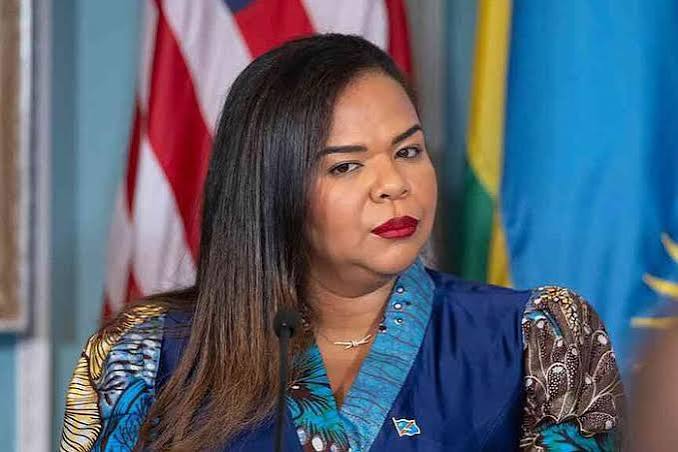
Kayikwamba rejected the comparison, arguing that Rwanda’s stated security concerns could not be equated with the scale of suffering experienced by civilians in eastern Congo.
“Mr Nagy, a perceived or real threat cannot be equated with thousands of people killed and millions displaced,” she said.
She referred to decades of violence, rape and forced displacement in eastern Congo, arguing that calls to sanction both sides overlooked the difference between the situations and suggested that Congolese lives counted for less.
Makolo criticised the Congolese minister’s response, saying it minimised the threat posed by the FDLR and the security concerns Rwanda has raised over the group’s continued presence in eastern Congo.
She also accused Congolese leaders of travelling internationally to defend the FDLR while attacking Rwanda, arguing that such a position would not contribute to peace.
“Congolese leaders travelling around the world to defend the FDLR while attacking Rwanda will not bring peace,” Makolo said.
The FDLR has operated in eastern Congo for decades and has roots in former Rwandan government forces and militia members who fled Rwanda after the 1994 Genocide against the Tutsi. Kigali considers the group a major security threat and has repeatedly called for its neutralisation.
Dispute over reciprocal security commitments
The disagreement reflects one of the main challenges facing implementation of the Washington Accords between Rwanda and the DRC.
Under the bilateral peace agreement signed in Washington on June 27, 2025, the DRC committed to implementing an agreed plan to neutralise the FDLR and its associated groups. Rwanda, in turn, committed to disengaging its forces and lifting defensive measures in accordance with the same security arrangements.
The two countries later established the broader Washington Accords for Peace and Prosperity on December 4, 2025, in a declaration witnessed by US President Donald Trump. The accords reaffirmed commitments to peaceful relations, regional security, economic integration and the safe return of displaced people and refugees.
However, the governments continue to disagree over whether the security commitments are being fulfilled.
On October 28, the US Department of the Treasury announced sanctions against Rwanda’s Ministry of Defence and Zigama Credit and Savings Society. Washington accused the ministry of directing troops operating alongside M23 in North and South Kivu and providing the group with military equipment, supplies, logistical support and training.
It also accused Zigama of facilitating payments for military equipment and financial transactions involving M23 and its political wing, the Congo River Alliance, as well as the transportation of gold from areas under rebel control in eastern Congo.
US Treasury Secretary Scott Bessent called on Rwanda to halt its alleged support for M23 and withdraw its troops from eastern Congo.
Rwanda denies supporting M23 and maintains that its security concerns, particularly the FDLR threat, must be addressed as part of the peace process.
Makolo reiterated that Rwanda remained ready to implement the Washington Accords, provided the DRC also demonstrated willingness to fulfil its obligations and the mediator held both parties accountable.
The exchange between the two officials underscores the continuing disagreement over responsibility for insecurity in eastern Congo and the reciprocal steps required to implement the peace agreement.