
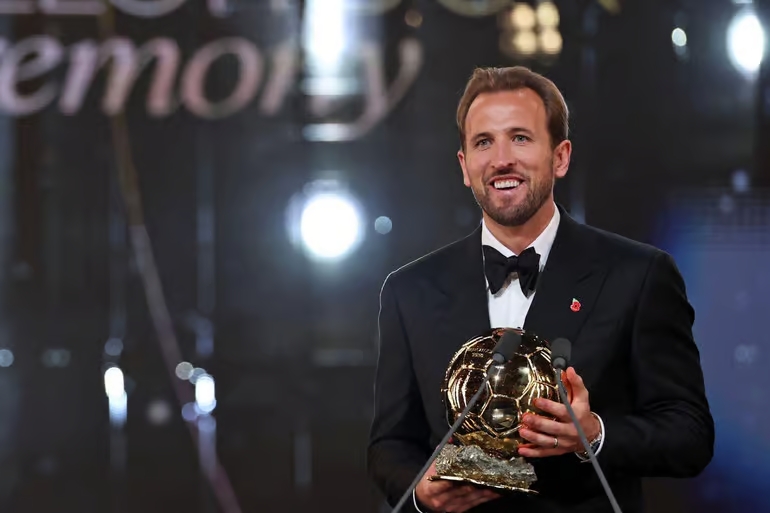
England captain Harry Kane won the 2026 men’s Ballon d’Or on Monday, becoming the first Englishman in 25 years to claim football’s most prestigious individual award, as the ceremony was held outside France for the first time in its 70-year history.
The Bayern Munich striker finished ahead of France’s Kylian Mbappé and Spain’s Lamine Yamal at the ceremony in London, organised by France Football magazine. Michael Owen was the last Englishman to win the award, in 2001.
Kane, 33, enjoyed a prolific 2025-26 season, scoring 61 goals in 51 appearances for Bayern and helping the German club win the Bundesliga and domestic cup. He also scored 12 goals for England, taking his total for club and country to 73 goals in 65 appearances.
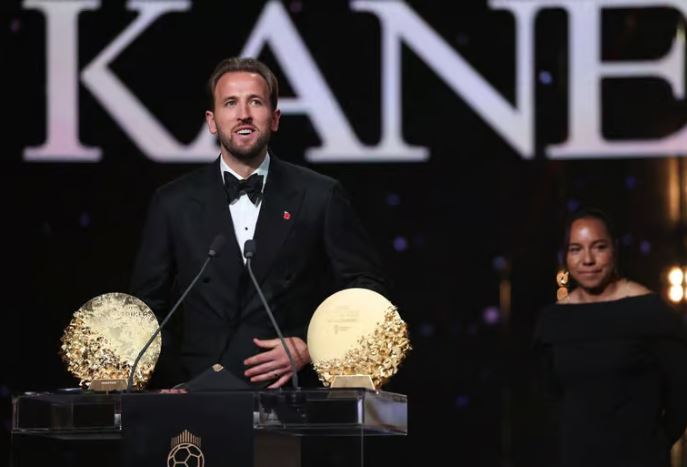
The victory made Kane the fifth Englishman to win the award, following Sir Stanley Matthews in 1956, Sir Bobby Charlton in 1966, Kevin Keegan in 1978 and 1979, and Owen in 2001.
Kane also won the men’s striker of the year award.
Mbappé, who played for Real Madrid, finished second, while Barcelona forward Yamal placed third. Yamal also won the men’s young talent award for the third consecutive year after scoring 24 goals and providing 18 assists for Barcelona during the season.
Spain goalkeeper Unai Simón won the men’s goalkeeper award, while Spain national team coach Luis de la Fuente was named men’s coach of the year. Paris Saint-Germain won the men’s club of the year award.
Arsenal and England forward Bukayo Saka received the Sócrates Award, which recognises footballers’ humanitarian and social contributions.
In the women’s category, Spanish midfielder Alexia Putellas won the Women’s Ballon d’Or for the third time. She had previously claimed the award in 2021 and 2022 while playing for Barcelona before joining London City Lionesses.
Barcelona won the women’s club of the year award, while other honours recognised achievements by players, coaches and goalkeepers across men’s and women’s football.
The ceremony, held in London on Monday, marked the first time the Ballon d’Or awards had been presented outside France since the prize was established by France Football in 1956. The choice of venue also paid tribute to Matthews, the inaugural winner.