
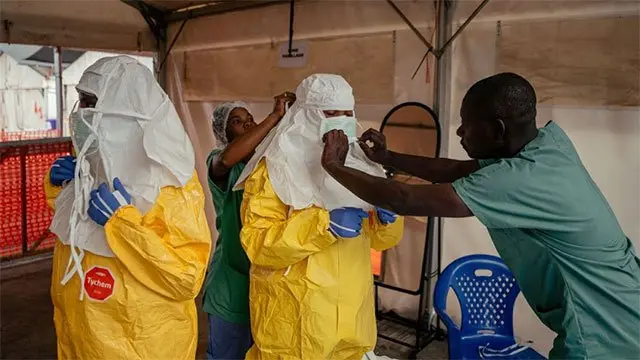
The Democratic Republic of Congo has banned mass gatherings in the capital Kinshasa and several provinces as authorities intensify efforts to contain an Ebola outbreak that has killed hundreds and remains concentrated in the country’s east.
Interior Minister Jacquemain Shabani issued the order Saturday, expanding earlier restrictions from affected regions to other parts of the country as a precaution against possible spread to Kinshasa, a city of about 18 million people that has reported no confirmed cases.
The measure also covers Tshopo, Haut-Uele and Bas-Uele provinces, which border the outbreak zone. Health officials say transmission remains concentrated in Ituri, North Kivu and South Kivu, where most infections have been recorded.
The health ministry said confirmed cases increased by 47 in a recent update, bringing total infections to 1,274 and deaths to 360. More than 90% of cases are in Ituri province, the epicentre of the outbreak.
Opposition leaders have criticized the ban, arguing it is aimed at blocking a planned protest march scheduled for July 8 against a proposed law they say could allow President Félix Tshisekedi to extend his time in office beyond constitutional limits.
Prince Epenge, speaking for the opposition Lamuka coalition, said there were no confirmed Ebola cases in Kinshasa and called the measure unjustified. Rodrigue Ramazani of the opposition Envol party urged supporters to proceed with the march, describing the restrictions as a political maneuver. The government has not responded to the allegations.
Health authorities say the outbreak is caused by the Bundibugyo strain of the Ebola virus, which spreads through direct contact with infected bodily fluids such as blood or vomit. There is no widely available vaccine for this strain.
The World Health Organization has warned that delayed detection and insecurity in eastern Congo are complicating response efforts, with armed groups limiting access for health workers in some areas.
Uganda has also reported cases linked to cross-border transmission.
Officials say surveillance and containment operations are continuing as they try to prevent further spread beyond affected regions.