
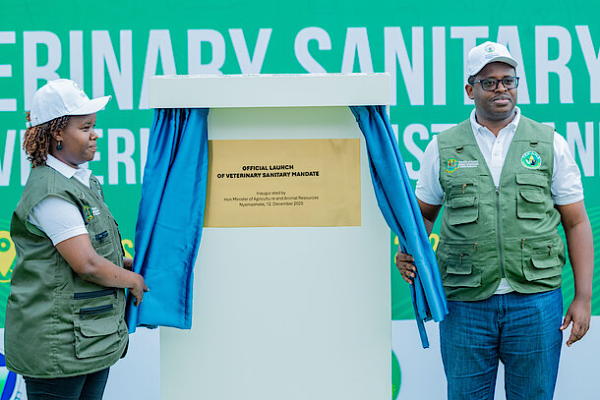
The Government of Rwanda has taken a significant step towards modernising the country’s livestock sector with the official launch of the Veterinary Sanitary Mandate (VSM) policy and the Veterinary Registration and Licensing Module under the Agriculture Management Information System (AMIS).
The launch took place on December 12, 2025, in Nyamasheke District, Western Province, signalling a major reform in veterinary service delivery nationwide and reinforcing Rwanda’s commitment to professional, efficient and accountable animal health systems.
The VSM represents a flagship national initiative aimed at professionalising veterinary services, strengthening private sector participation, and improving coordination across the animal health value chain. The reform responds to long-standing gaps in veterinary service delivery identified in national assessments and aligns with key government policy frameworks, including the National Strategy for Transformation (NST2) and the fifth Strategic Plan for the Transformation of Agriculture (PSTA5).
Livestock plays a central role in Rwanda’s rural economy, contributing to household income, nutrition and food security. Cattle, goats, pigs and poultry are widely integrated into smallholder farming systems, while flagship programmes such as Girinka (one cow per poor family) have expanded livestock ownership and boosted milk consumption nationwide. As the sector grows, demand for reliable veterinary services, disease control and improved animal productivity has increased significantly.
Under the new framework, 34 companies accredited by the Rwanda Agriculture and Animal Resources Development Board (RAB) are currently eligible to bid for veterinary service tenders in their respective districts. This structured approach is intended to ensure quality service provision, improve accountability and ensure that farmers receive timely and professional veterinary support.
Speaking at the launch, Dr. Olivier Kamana, the Permanent Secretary at the Ministry of Agriculture and Animal Resources (MINAGRI), emphasised the critical contribution of livestock to Rwanda’s economy and rural livelihoods. He called on veterinarians to deliver high-quality, farmer-centred services, stressing that strong veterinary systems are essential to national prosperity and agricultural transformation.
Dr. Kamana noted that the rapid expansion of the livestock sector has outpaced the capacity of existing government staff. He explained that more than 55% of sector-level personnel are trained in livestock production but lack formal veterinary qualifications, limiting their ability to provide specialised animal health services.
“The reforms we are introducing are meant to bridge these gaps by deploying qualified veterinary professionals where they are most needed,” he said, adding that improved animal health services are key to increasing milk production, reducing disease-related losses and strengthening overall livestock productivity.

A major pillar of the reform is the digitalisation of veterinary registration and licensing through the AMIS Veterinary Registration and Licensing Module. The platform streamlines procedures, improves data management and ensures that professional standards are consistently applied across the country. By replacing fragmented manual systems, the digital module enhances transparency, efficiency and traceability in the regulation of veterinary practice.
Digital tools are increasingly shaping Rwanda’s agricultural sector, from farm input management to market information systems. In the veterinary field, the AMIS module is expected to support better planning, facilitate monitoring of service delivery and provide policymakers with reliable data to inform disease surveillance and livestock development strategies.
Rwanda currently has 6,220 veterinary professionals, including 660 veterinary doctors, 320 livestock production specialists and 5,240 veterinary technicians. Notably, 88% of these professionals operate in the private sector, underscoring the importance of public- private collaboration in delivering animal health services.
Under the VSM, private veterinary practitioners are required to operate through registered companies that obtain a Veterinary Sanitary Mandate via a restricted tendering process. These companies are contracted to deliver services within designated districts and are required to submit monthly activity reports to district authorities and RAB. This reporting mechanism is designed to ensure accountability, performance monitoring and alignment with national animal health priorities.
Professional oversight will continue to be provided by the Rwanda Council of Veterinary Doctors (RCVD), which is responsible for capacity building, ethical standards and disciplinary measures within the profession. At the local level, District and Sector Animal Resources Officers will oversee monitoring and evaluation, ensuring that services respond to community needs and adhere to regulatory requirements.
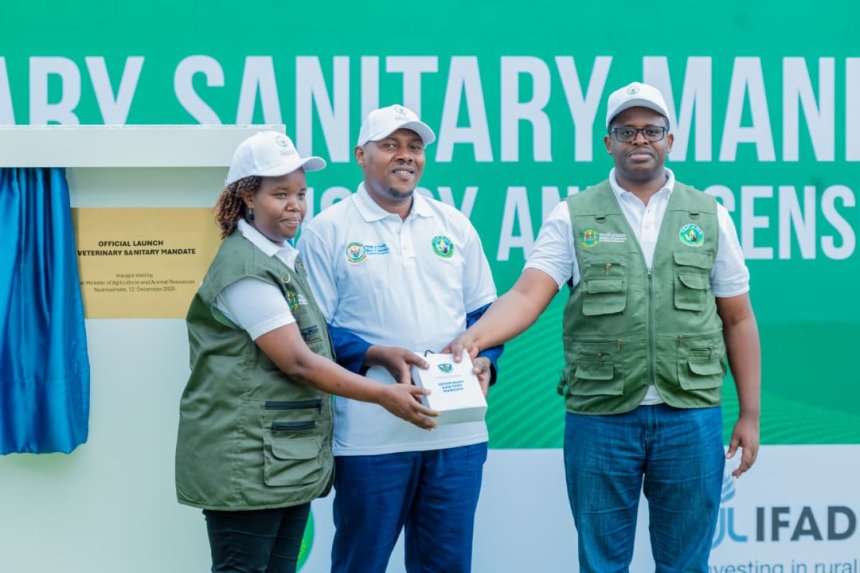
The launch event brought together a wide range of stakeholders, including senior government officials, veterinary practitioners from both the public and private sectors, insurance companies, farmer organisations, development partners and community representatives. Their participation highlighted the multi-sectoral nature of veterinary services and the shared responsibility for safeguarding animal health.
Officials say the initiative will help reduce the incidence of livestock diseases, improve animal welfare and boost productivity, particularly among smallholder farmers who rely heavily on livestock for income and nutrition. Better veterinary coverage is also expected to support the growth of livestock-related value chains, including dairy, meat and leather industries.
By professionalising veterinary services and embracing digital regulation, Rwanda is laying the foundation for a more resilient and competitive livestock sector. The reforms reflect a broader national commitment to evidence-based policy, private sector engagement and service delivery that meets the needs of farmers.
As Rwanda pursues its agricultural transformation agenda, the VSM and AMIS licensing system are expected to play a pivotal role in strengthening animal health systems, enhancing farmer confidence and supporting sustainable growth in the livestock industry.