
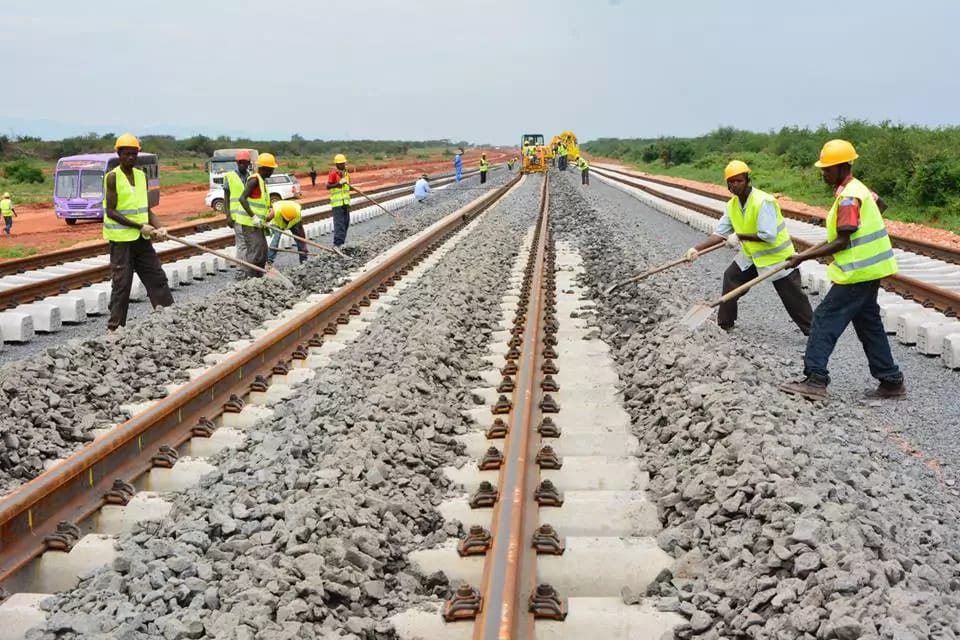
RWANDA’s bold plan to build a modern, electric standardgauge railway linking Kigali to Tanzania’s Isaka is closer to reality, but it still needs a critical regional push and strong financial backing to take off.
Rwandan and Tanzanian officials recently said construction on the 571-kilometre Isaka–Kigali railway could begin as soon as December 2025, once a contractor is selected. But for Rwanda’s $1.3 billion portion towards the project, longterm financing remains a hurdle.
Jean de Dieu Uwihanganye, Rwanda’s Minister of State for Transport, told The Dawn that the feasibility study is already complete. “Rwanda is looking for a staggering around $1.3 billion to finance its portion with the aim of reducing logistical costs, boosting trade and easing the movement of people between Tanzania and Rwanda,” he said.
To date, the Development Bank of Southern Africa (DBSA) has committed $100 million toward the project. Hildabertha Kundu, the DBSA’s Regional Manager for Central and East Africa, noted that the bank sees the railway as more than an infrastructure project, but rather a development lifeline. “For us, it is about development and impact. Connecting these countries by rail will reduce the number of cargo trucks on the roads, which will eventually increase the lifespan of the roads,” she explained.
Costly, but worthwhile project President Paul Kagame has underscored the need for regional cooperation to make the railway a success. He has called for a “joint mobilisation campaign” with neighbouring countries to iron out the challenges, noting that Rwanda’s “strong historical ties have always been central to our cooperation.”
Still, the financial picture is getting more complex. Rising construction costs — fueled by inflation and currency pressures recently pushed Rwanda’s section estimate to $857 million, according to local reports. However, Infrastructure Minister Gatete defended the plan, saying the long term benefits justify the steep price. “Once we start, we do not stop,” he told reporters.
To support the project, Rwanda has already earmarked 370,000 square metres for two key terminals: a passenger terminal in Ndera and a cargo terminal in Masaka. These will be linked to express highways and bus rapid transit routes, transforming them into major transport hubs for the region.
Business leaders in Rwanda are watching closely. Deus Kayitakirwa, the Director of Advocacy at the Private Sector Federation, said the railway could dramatically cut import costs. “Of course, the cost of import will reduce and the f inal consumer will benefit,” he said, adding that more affordable transport could lower the price of goods by reducing the “40 percent” of import costs that stem from logistics.
According to Rwanda’s infrastructure planning documents, the long-term rewards are significant: projected annual revenue of $367 million by 2025, with traffic expanding steadily over the decades. However, much depends on the politics and delivery.
If Tanzania and Rwanda both follow through, the rail line could become a cornerstone of regional trade and connectivity. If not, it risks remaining a grand vision waiting for its moment