

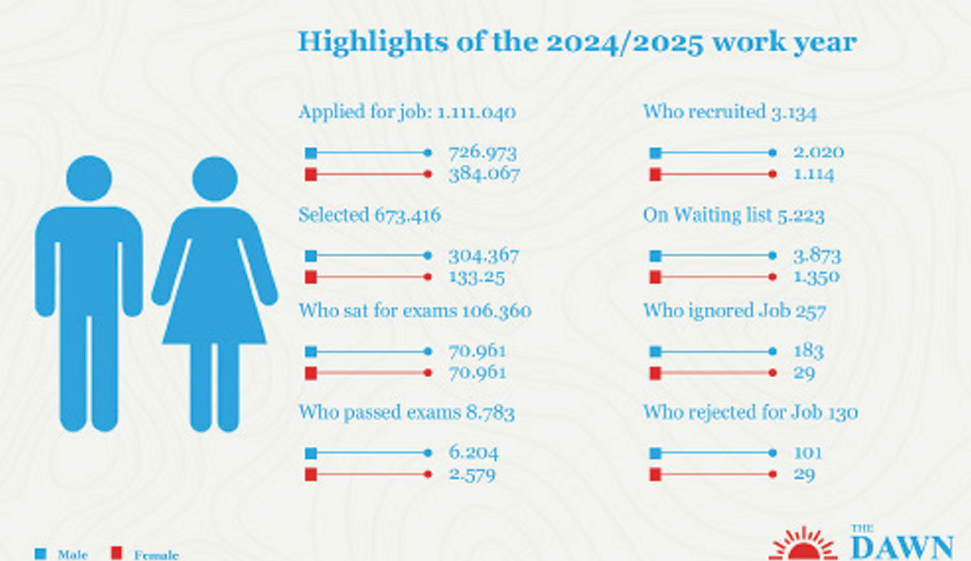
Rwanda’s National Public Service Commission (NPSC) report for the 2024/2025 fiscal year reveals a widening divide between the public’s demand for government jobs and the limited number of positions available, with an especially pronounced disadvantage for women. According to the report, 1,111,040 people applied for public-sector jobs, but only 3,134 were ultimately recruited. Of the total applicants, 673,416 met the minimum requirements, yet just 106,360 sat the job interviews. In those tests, 8,783 passed, but only a fraction of them – only 3,134 – received job offers.
The commission also recorded 13,226 recruitment appeals during the year, of which 5,431 were upheld. Audits carried out by the NPSC in 74 public institutions uncovered recurring problems, including failure to verify candidates’ qualifications, ignoring academic equivalencies, and appointing recruitment panels that did not meet required standards. The report highlights a persistent gender disparity in public job applications and subsequent offers.
While it does not provide exact hiring breakdowns by gender, separate parliamentary analysis has long shown that men apply for public jobs at far higher rates than women. Lawmakers have called for a deeper investigation into why women are underrepresented among applicants, citing potential structural and social factors.
Experts say these recruitment figures reflect larger challenges in Rwanda’s labour market. With rapid population growth and a swelling labour force, many are turning to the public sector as a stable employment option. But the government’s capacity to absorb this demand appears limited. “In a country where so many people look to the Government for employment, the fact that only a tiny fraction get hired shows that public sector growth is not keeping pace,” said Dr Claudine Uwimana, a labour economist based in Kigali. “We need stronger private sector engagement and policies that ensure women are not left out.” However, the NPSC report shows some progress. Of the 240 recommendations made in recent years to improve Other key recommendations were providing resources for efficient operations, making complaint and dispute resolution easier and accessible, enhancing performance systems by ensuring fair evaluations and aligning HR systems with regulations.

Concerns linger
Observers say recruitment processes remain opaque, especially for applicants from rural areas who may lack access to appeal mechanisms or face logistical barriers. The broader economic context adds urgency to these issues.
According to Rwanda’s Labour Force Survey, unemployment remains a major challenge. The most recent survey shows unemployment falling from 16.8% in mid-2024 to 13.4% in the second quarter of 2025, but a significant gap persists between men and women in labour force participation.
For many young Rwandans, especially recent graduates, the NPSC report confirms a familiar frustration: public-sector employment is seen as a secure path, but the road to getting hired is narrow and fiercely competitive. Ingabire Diane, 25, a graduate and resident of Kigali city, believes that lack of experience and ‘connections’ is the reason she has failed to get a job.
“Don’t rely only on public sector jobs. While applying, build your skills through volunteering or short-term contracts. Experience is experience, even if it is not formal employment,” she says. Eric Habimana, who has been unemployed for five years after he completed his studies, says the process of getting a public service job is very competitive. “Every time the Public Service Commission posts vacancies, thousands apply. Even with good grades, you might fail because the selection exams are tough and require very specific knowledge.
Another issue is that some job descriptions are unclear, so you don’t know exactly what to study for,” he says. Habimana adds that the Public Service Commission should offer free training sessions on job application, such as sample tests or online practice questions. “If you fail an exam three times without feedback, you don’t know how to improve.”