

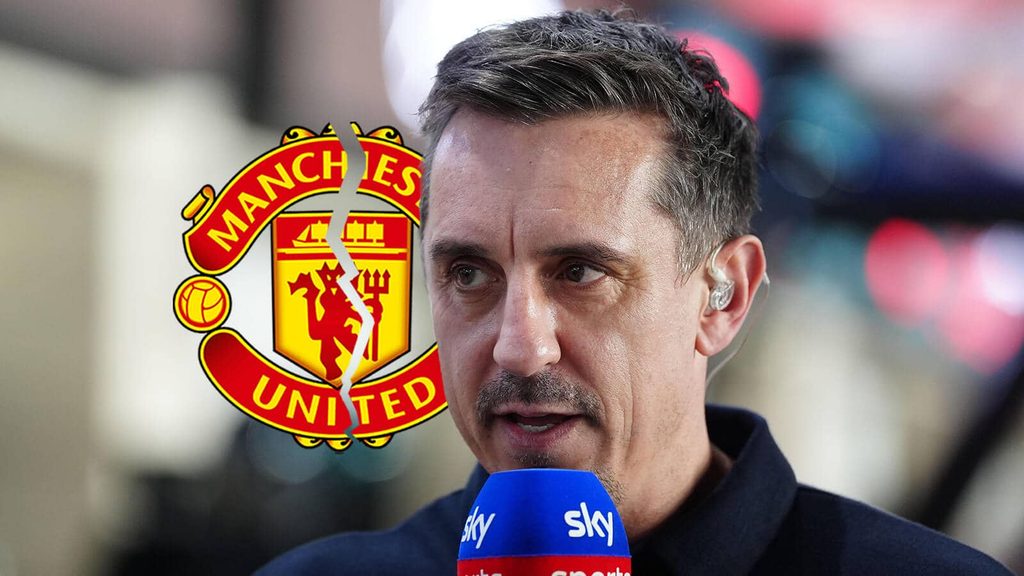
Former Manchester United captain Gary Neville has blamed the club’s hierarchy for failing to strengthen the defence during the summer transfer window after the team conceded four goals in a 4-4 draw against Aston Villa on Sunday.
United twice came from two goals behind at Old Trafford, with Joshua Zirkzee and Patrick Dorgu scoring in second-half stoppage time to secure a point against Unai Emery’s side.
Villa had taken a 2-0 lead in the first half before moving 4-2 ahead after the break.
Neville said United’s defensive problems were a consequence of the club’s failure to recruit defenders despite the need being clear before the season.
“The reason Manchester United have conceded four goals is because they haven’t invested in the defence in the transfer window,” he said. “Every one knew they had to do that, they needed defenders.”
His brother Phil Neville was equally critical, arguing that the back four which finished the match — Noussair Mazraoui, Leny Yoro, Ayden Heaven and Dorgu — was not strong enough to keep United in the Premier League.
“That back-four gets you relegated,” Phil Neville said. “It’s poor. It’s not good enough to play in the Premier League.”
The result added to the pressure on manager Michael Carrick, although Gary Neville questioned whether another change in the dugout would solve the club’s problems.
He argued that United had repeatedly changed managers without addressing deeper weaknesses in recruitment, performance management and leadership.
Neville pointed to the succession of managers over the past 12 years, including Jose Mourinho, Louis van Gaal, David Moyes, Ole Gunnar Solskjaer, Ralf Rangnick, Erik ten Hag and Ruben Amorim, saying the pattern showed that managerial changes alone were not the answer.
“If you recruit badly, if you’ve got poor performance department, poor recruitment department, you’ve not got leadership that is strong right through the spine of the football club you will fail,” he said.
He added that the club’s ownership and senior leadership appeared uncertain about how to address the problems, warning that the issues extended beyond the manager.