

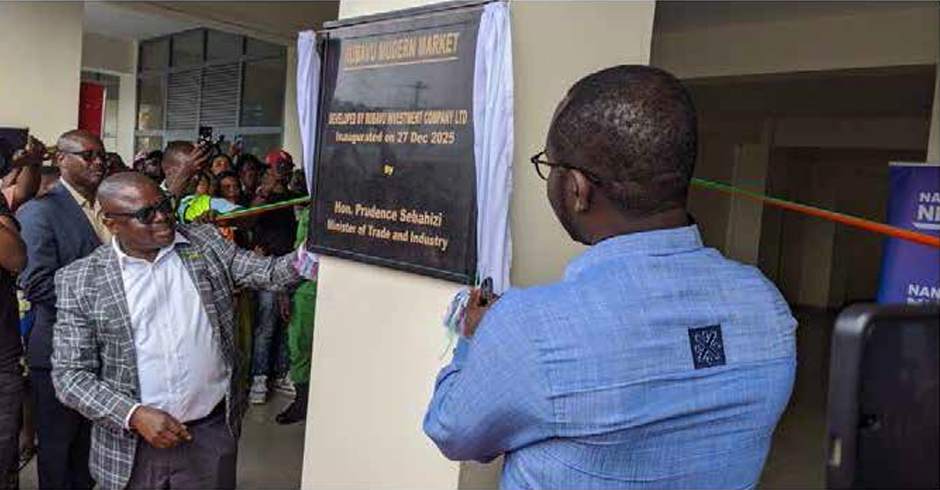
After a 15-year construction saga marked by delays, disputes, and shifting administrative priorities, Gisenyi’s long-awaited modern market has finally opened its doors, ushering in renewed optimism for trade and enterprise in Rwanda’s Western Province. The official inauguration took place on Saturday, December 27, 2025, led by the Minister of Trade and Industry, Prudence Sebahizi, bringing closure to a project that has tested the patience of residents, traders, and local authorities alike.
For residents of Rubavu District and traders who depend heavily on cross-border commerce with neighbouring Democratic Republic of Congo (DRC), the opening of the market is more than a symbolic achievement. It represents a long-anticipated economic lifeline, one expected to stimulate local commerce, formalize informal trade, and strengthen Rubavu’s position as one of Rwanda’s busiest commercial gateways.
Situated near the Gisenyi–Goma border, the market is strategically placed within a region that has historically served as a hub for cross-border exchange. Every day, hundreds of traders move agricultural produce, manufactured goods, and household items between Rwanda and the DRC. The new facility arrives at a time when Rwanda continues to invest in modern trade infrastructure as part of its broader ambition to boost domestic commerce, regional integration, and private sector-led growth.
A long road to completion
Construction of the Gisenyi market began in 2010, buoyed by expectations that it would modernize trading conditions in Rubavu District. However, the project soon stalled due to insufficient funding, leaving the unfinished structure idle for years. Matters grew more complicated when the project was handed over to ABBA Ltd, a move that triggered controversy, leadership changes, and protracted legal disputes.
These challenges culminated in 2015 with the dismissal of former Rubavu District Mayor Sheikh Bahame Hassan. Subsequent investigations revealed irregularities in the initial contract, including premature construction activities and unauthorized loan applications by district officials. The findings highlighted gaps in oversight and governance that further delayed progress.
Court proceedings dragged on for several years, deepening uncertainty around the project’s future. In 2017, the courts ruled in favor of the district, officially returning the market to Rubavu authorities. A Cabinet decision in 2019 later cleared remaining administrative hurdles, creating space for private investors to step in and complete the project under a public-private partnership framework.
By 2021, local investors operating under Rubavu Investment Company (RICO) were contracted to finalize construction. The total public-private investment amounted to more than RWF 4.7 billion. Despite renewed momentum, the project still faced technical challenges. The region’s volcanic soil required additional engineering work and further district investment, once again slowing progress. Nonetheless, after years of persistence, the market is now complete and operational.
Expectations from residents and traders
For local traders, the modern market offers the promise of transformation. Many had previously operated in congested, informal spaces exposed to weather hazards and lacking basic amenities such as sanitation, storage, and organized stalls. The new infrastructure is expected to improve hygiene standards, enhance safety, and create a more dignified trading environment. “With proper stalls and storage facilities, we can protect our goods and attract more customers,” said one vendor at the opening ceremony.
Traders anticipate that the organized layout and improved facilities will translate into higher sales and more stable incomes. Cross-border traders, who form a significant part of Gisenyi’s commercial ecosystem, are equally optimistic. “This market will make our trade faster and more organized,” says Gilbert Bagumya, a trader from Gisenyi-Goma. “We expect more customers now that the facilities are modern, and we can expand our businesses safely.” He adds.
Residents of Rubavu District are also hopeful about the broader economic ripple effects. Transporters, food vendors, service providers, and small shop owners in nearby sectors expect increased foot traffic and new employment opportunities. Improved access to daily goods and services is anticipated to enhance livelihoods and support household economies.
In a country where markets play a central role in connecting farmers, traders, and consumers, the Gisenyi market is envisioned not merely as a place of exchange, but as a focal point for community development and urban renewal.
A hub for the future
The Gisenyi Modern Market stands as a symbol of perseverance, public-private cooperation, and the promise of economic revitalization. Beyond boosting cross-border trade with the DRC, it is expected to strengthen Rubavu District’s role as a commercial hub in the Western Province, reinforce local supply chains, and support Rwanda’s broader trade ambitions within the Great Lakes region.
As Rwanda continues to prioritize infrastructure development, trade facilitation, and regional integration, facilities such as the Gisenyi market are critical in translating policy into tangible benefits for citizens. For the people of Gisenyi, the long wait is finally over. The market represents a fresh start—a place where commerce, community, and opportunity converge.