
Rwanda’s growing domestic revenue collection is reinforcing the government’s drive toward economic independence, as officials point to improved tax compliance, digital systems and stronger citizen engagement as key pillars of sustainable development.
The Rwanda Revenue Authority (RRA) collected 3,099 billion Rwandan francs (about $2.3 billion) in tax and non-tax revenues during the last fiscal year, exceeding its target of 3,041.2 billion francs.
The performance represents 101.9 percent of the target and a 17.4 percent increase compared with the previous year, highlighting steady progress in domestic resource mobilization.
Prime Minister Justin Nsengiyumva said the results demonstrate the importance of relying on internal resources to finance national development priorities. “Paying taxes is a sign of responsibility and commitment to the country,” Nsengiyumva said, noting that dependence on unpredictable external assistance weakens long term planning and national ownership of development programs.
Rwanda, like many developing countries, has experienced a gradual decline in foreign aid. Nsengiyumva said external funding has fallen from 37 percent of the national budget 15 years ago to just 8.3 percent today, describing the trend as a clear signal for the country to strengthen self-reliance through domestic revenues.
Finance and Economic Planning Minister Yusuf Murangwa said revenues collected by RRA accounted for 55.1 percent of the national budget in the 2024–2025 fiscal year, up from 44.7 percent five years ago. He said the increase reflects progress toward fiscal sustainability and greater economic autonomy.
Murangwa added that the government will continue prioritizing private investment and economic transformation, noting that 62.8 percent of the current budget is allocated to growth-oriented sectors. He said this allocation demonstrates confidence in Rwanda’s ability to sustain development through domestically generated resources.
RRA Commissioner General Ronald Niwenshuti attributed the revenue gains to improved collaboration with taxpayers and the expansion of digital tools that simplify compliance.
These include electronic billing machines, online declaration systems and mobile payment platforms, which have enhanced transparency and reduced tax leakages.
“We are committed to making tax processes easier and more transparent,” Niwenshuti said, expressing confidence that RRA will meet its 2025–2026 target of collecting 3,728.2 billion francs in tax and non-tax revenues.
The Private Sector Federation welcomed the government’s approach, with its chairwoman, Jeanne Françoise Mubiligi, praising efforts to strengthen transparency and accountability in public f inance management.
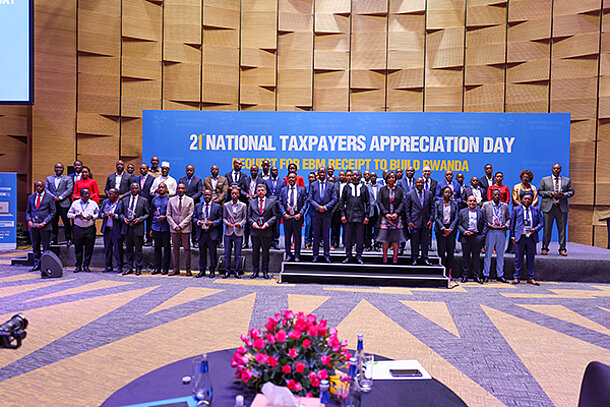
She said predictable and fair tax systems are essential for private sector growth and investor confidence. During the event, 20 taxpayers were recognized for exemplary compliance, based on timely tax payments, adherence to tax laws, use of electronic billing machines and the absence of tax arrears or repayment agreements.
RRA also honored an outstanding consumer from Kigali for consistently requesting electronic billing receipts, underscoring the role of citizens in strengthening domestic revenue collection.
As Rwanda advances toward its long-term development goals, rising domestic revenue is increasingly seen not only as a fiscal achievement, but also as a foundation for economic independence and national resilience.