
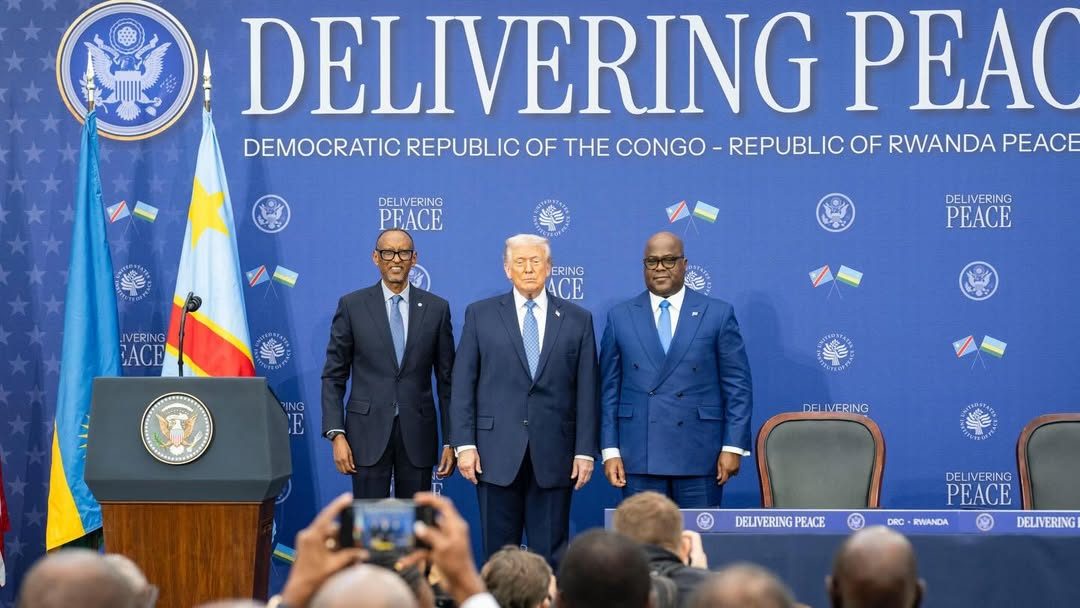
A pivotal moment in the history of the Great Lakes region unfolded at the United States Institute of Peace in Washington, D.C., on 4 December 2025.
The long anticipated peace and prosperity agreement between the Presidents of Rwanda and the Democratic Republic of Congo (DRC), Paul Kagame and Félix Tshisekedi, was officially signed in the presence of U.S. President Donald Trump, African leaders, and international dignitaries.
This historic accord marks the beginning of a new chapter towards peace, stability, and cooperation between the two nations, which have endured decades of conflict.
The signing of the Washington Accords follows years of instability, violence, and failed peace negotiations.
The event in Washington was not only a formalisation of the terms agreed upon in June but also a symbolic moment for both countries, signalling a commitment to ending a conflict that has claimed millions of lives over the past three decades.
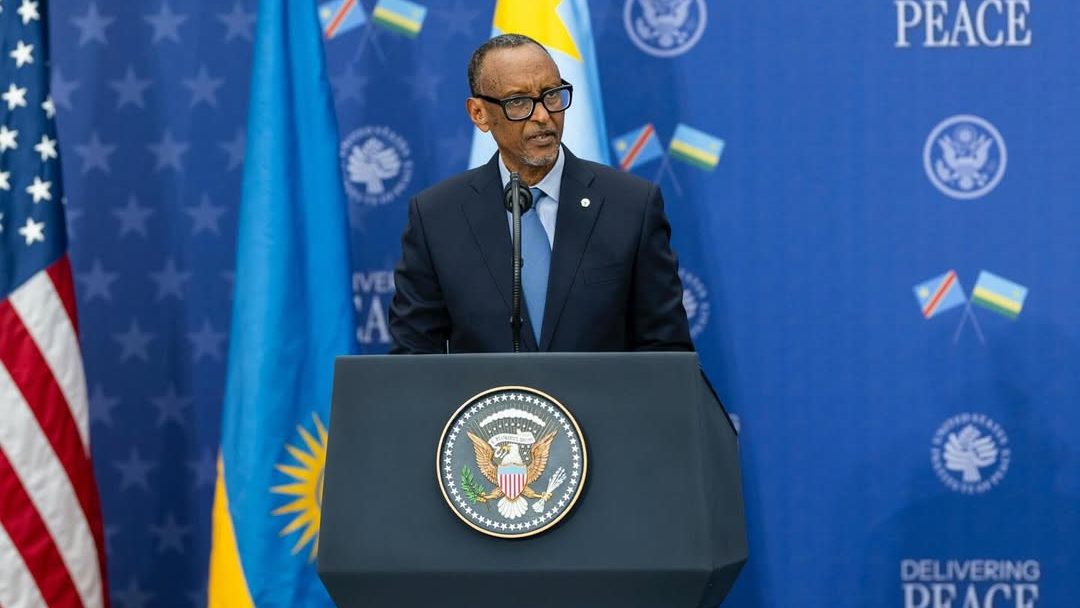
As President Kagame took the stage, he expressed his gratitude to the leaders and countries who had played a significant role in bringing about this momentous occasion.
In his speech, he particularly thanked the U.S. President Donald Trump for his leadership and the role of Qatar in facilitating the peace talks.
“President Trump introduced a new and effective dynamism that created the space for breakthroughs,” Kagame said.
He went on to emphasise the importance of the U.S.’s involvement, which played a critical role in resolving what had seemed an intractable conflict.
Kagame also reminded the international community that responsibility for the success of the agreement lies with Africa.
“If this agreement falters, the responsibility will not lie with President Trump, but with ourselves,” he said, stressing Rwanda’s unwavering commitment to a safe and secure future. “It is up to us in Africa, working with our partners, to consolidate and expand this peace. There will be ups and downs on the road ahead. There is no doubt about it. Rwanda, I know, will not be found wanting. I can assure you of that,” the head of state added.
In his address, Congolese President Félix Tshisekedi expressed deep gratitude for the efforts of President Trump and other partners, including Angola, Qatar, and former Kenyan President Uhuru Kenyatta, who had mediated earlier peace initiatives such as the Luanda and Nairobi processes.
Tshisekedi characterised the Washington Accords as a turning point for the region, a chance to overcome decades of violence and displacement.
“The Washington Agreements are not yet another document. These represent a turning point,” Tshisekedi remarked.
“They bring together a declaration of principles, a peace agreement, and a regional economic integration framework to provide the peoples of the region with a new perspective, a new outlook.” The DRC President also called for mutual respect and non interference, outlining a future of cooperation in which both countries would work together to combat armed groups, prevent further violence, and begin a shared journey towards prosperity.
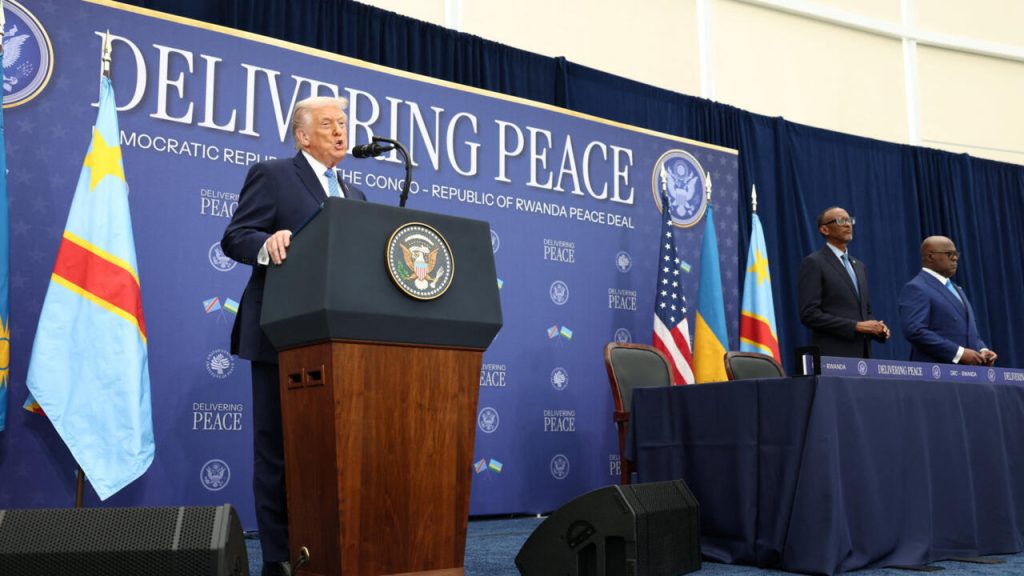
President Trump’s Reflection
U.S. President Donald Trump, in his remarks, underscored the significance of the Washington Accords not only for Rwanda and the DRC but for the entire world.
Speaking from the newly inaugurated United States Institute of Peace, Trump praised both leaders for their courage and determination to bring an end to one of the longest-running conflicts in modern history.
“This is a special occasion for a lot of reasons, but number one is it’s our first occasion in this building using it for peace,” Trump stated.
He emphasised that the day marked a monumental shift for the two countries, ending years of war and beginning a new era of harmony and cooperation.
Trump also highlighted the broader impact of the agreement, noting that the U.S would work with Rwanda and the DRC to unlock new economic opportunities, particularly in the mining and mineral sectors, benefiting both nations and the United States.
“For more than 30 years, one of the worst conflicts on earth has been raging in eastern Congo,” Trump said, noting the devastating loss of life and destruction caused by the conflict. “Today, we are succeeding where so many others have failed.”
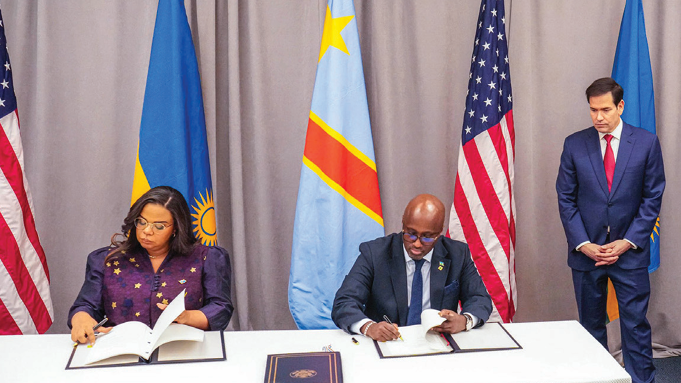
A Framework for Economic Cooperation
The economic implications of the peace deal were equally significant. Alongside the final peace agreement, Rwanda’s Foreign Minister Olivier Nduhungirehe signed two key bilateral agreements: the Regional Economic Integration Framework (REIF) with the DRC, and a framework agreement with the United States aimed at shared economic prosperity.
These agreements are designed to foster economic growth, trade, and investment in areas such as energy, infrastructure, and mineral supply chains.
Nduhungirehe expressed optimism about the potential for Rwanda and the DRC to collaborate closely on these issues, emphasising the importance of joint efforts in creating opportunities for the people of both countries.
“The REIF creates economic opportunities for DRC and Rwanda to make joint investments in energy, infrastructure, mineral supply chains, national park management, and tourism,” Nduhungirehe said via his X account after the agreements were signed.
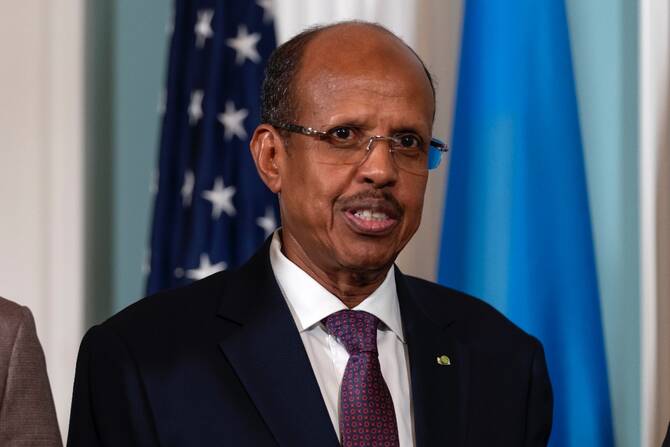
The African Union Welcomes the Milestone
The African Union (AU) also praised the signing of the Washington Accords.
The Chairperson of the AU Commission, Mahmoud Ali Youssouf, through an official statement, congratulated both countries for their commitment to peace and stability.
He acknowledged the critical role played by the United States in facilitating the negotiations and thanked Qatar for its diplomatic support.
Youssouf also commended African leaders, including those from Angola and Togo, for their continued involvement in the peace process.
“The African Union stands ready to accompany the parties and regional mechanisms in advancing this vital process for the benefit of the peoples of the DRC, Rwanda, and the wider region,” Youssouf said in a statement following the signing.
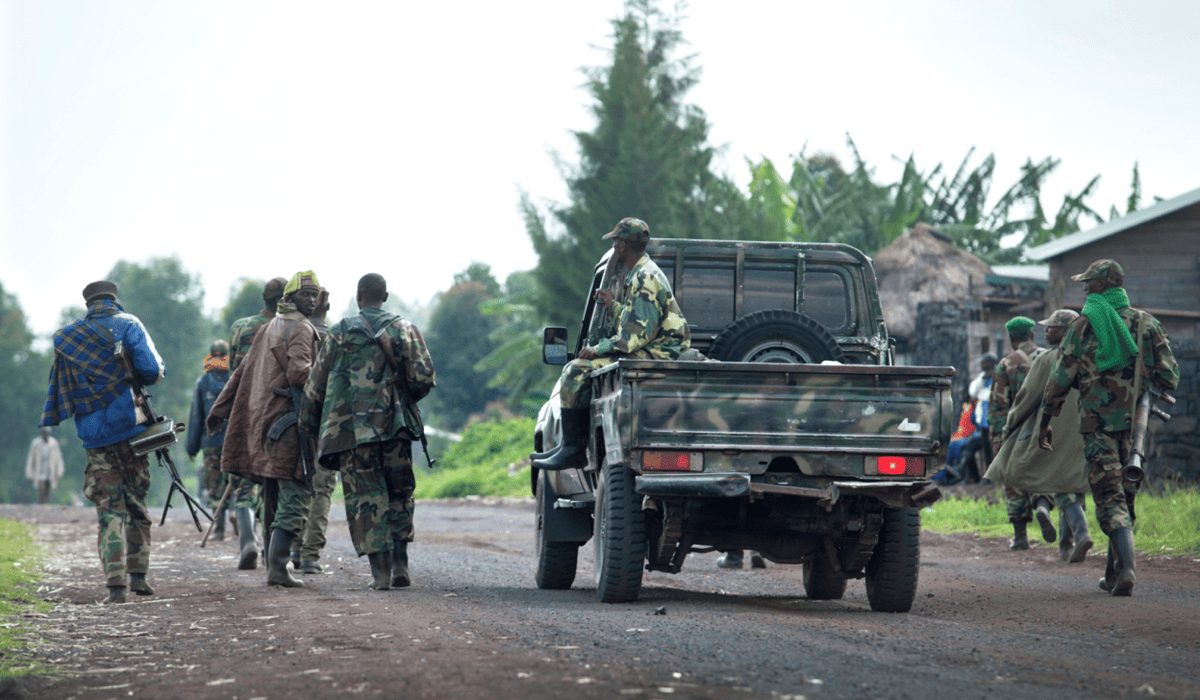
Background to the Conflict
The conflict in eastern DRC has spanned decades, despite the intervention of the United Nations Organization Stabilization Mission in the Democratic Republic of the Congo (MONUSCO), which has been accused of abusing its mandate by siding with the DRC government and coalition armed groups during the fighting with the M23 rebel group.
The M23 resumed fighting in 2021, citing unresolved grievances and accusing Kinshasa of failing to implement peace accords.
The M23 claimed to be defending the rights of marginalised Tutsi communities in the DRC, while the government of the DRC has at times been accused of ethnic cleansing, with some officials inciting public hatred against Tutsi communities.
As the war with the M23 intensified, East African regional forces intervened, leading to a temporary ceasefire and the M23’s withdrawal from captured areas in 2023.
These areas were ceded to the East African Regional Forces (EACRF), despite the DRC’s rejection of Rwandan troops, who were part of the EAC.
However, pressure from the DRC on the EACRF grew, urging them to take actions beyond their mandate, including launching offensives against the M23.
Amid these tensions, the DRC unilaterally expelled the EACRF and negotiated with SADC forces to intervene, launching their own offensives in collaboration with the Burundian government.
Despite these efforts, the M23 continued to gain ground in eastern DRC, capturing more territory.
While the DRC, a country with more than 200 armed groups, faced setbacks, it continued to accuse Rwanda of supporting the M23, a claim Rwanda has repeatedly denied.
Instead, Rwanda accuses the DRC of collaborating with the FDLR, a terrorist group composed of remnants of the 1994 Genocide against the Tutsi.
Additionally, Congolese Sukhoi fighter jets violated Rwandan airspace multiple times, including a brief landing at Rubavu Airport.
These actions prompted Rwanda to strengthen its defensive measures along its border to safeguard its sovereignty.
Diplomatic tensions between Kigali and Kinshasa escalated further in 2022, when the DRC expelled Rwanda’s Ambassador.
Despite these tensions, Rwanda consistently denied allegations of supporting the M23 rebellion, which has seized significant territory across North and South Kivu provinces.
Rwanda’s main security concern remains the presence of the FDLR militia in the DRC, a group it considers a serious threat due to its ties to the perpetrators of the 1994 Genocide.
The fighting continued, with the M23 gradually defeating the DRC’s coalition forces, including the Wazalendo militia, FDLR, Burundian forces, and SADC troops, leading to the capture of Goma in January 2025 and Bukavu shortly afterwards.
During the Goma offensive, shells were fired from the DRC into Rwanda, but Rwandan troops intercepted them, protecting civilians.
Later, Rwanda revealed that stockpiled weapons in Goma suggested a plan to attack Rwanda.
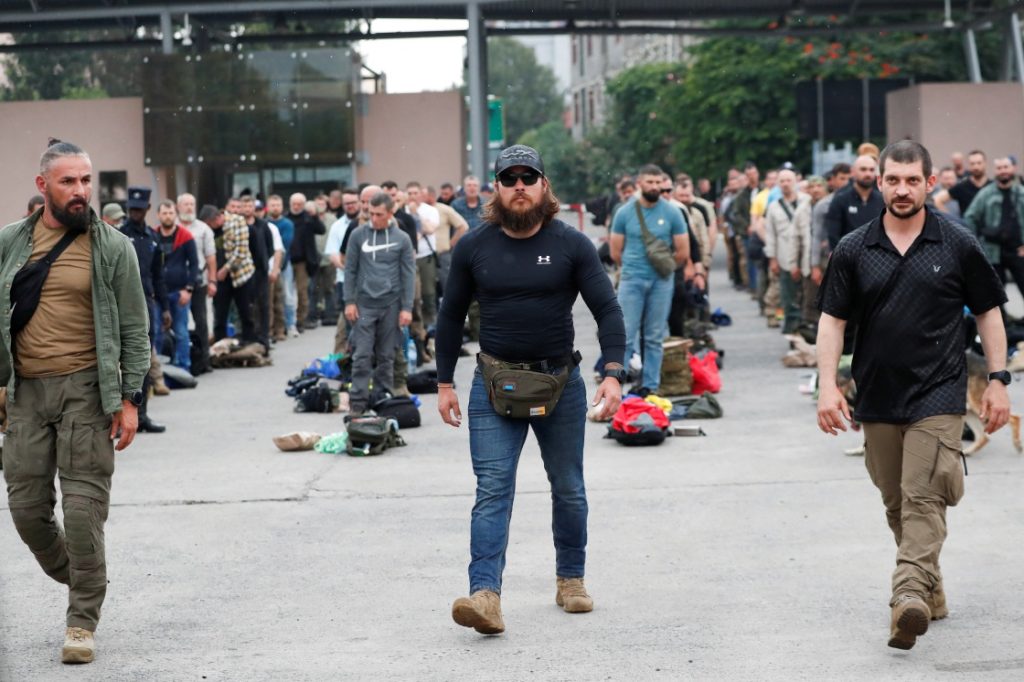
More than 270 European mercenaries working with the Congolese government were captured during the Goma assault and were allowed to return home through Rwanda.
SADC troops also sought passage through Rwanda after their defeat.
The crisis had been the subject of various mediation attempts, including the Luanda process, which failed due to last-minute shifts in the DRC’s stance, undoing progress made in negotiations.
A turning point came in March 2025, when Qatar facilitated talks between Presidents Kagame and Tshisekedi in Doha.
Since then, negotiations have proceeded smoothly, despite occasional ceasefire violations.
The Washington process and the Doha process worked towards ending longstanding rivalries, with the latter focusing on mediation between the DRC and the M23 rebel coalition.
Despite setbacks, a peace agreement was signed in June between Rwanda and the DRC, followed by the initialisation of the economic cooperation framework.
However, the final deal was delayed until 4 December 2025, when a breakthrough was made in Washington, D.C. With these new agreements, there is hope for peace in eastern DRC and the eventual return of refugees, among other positive developments.
However, it remains to be seen whether the commitments outlined in the accords will hold.